Saturday, June 18, 2011

Going Rogue: The LCBO's Rogue Brewery June Release

Every once in a great while, a release happens at the LCBO that more or less makes up for all the annoyances and stupidity we've had to endure over the previous several months.   I sometimes see the LCBO as being the dopey, lazy husband sitcom character - means well, generally is a good person, but nevertheless is incredibly stubborn and prone to colossal fuck-ups.   But, thanks to some sage advice from its rarely-seen neighbour, he will inevitably produce some sort of well-meaning make-up gesture that saves the relationship for at least another week.   In the past few months, we the beer-sloshing masses have had to endure the same basic beer lineup with minimal changes, and when it looks like things are changing for the better, what follows is the kind of tragic dumb-fuckery such as what was seen with the "Smashbomb Affair." (which looks like it has finally been resolved!)  At this point I was ready to go full on Tea Party and campaign for the abolishment of this governmental interference in our private lives. The market will fix itself, and all that. Fortunately, the stars did align and the LCBO graced us with a lovely little bonus release from on the United States' classic craft breweries, and all was forgiven. That is, at least, until the next time the LCBO forgets our anniversary and goes drinking with his buddies.


Rogue Brewery from Newport Oregon is, as I have said, one of the big names in the American West Coast craft brewing scene.  One of the first biggies out of the gate (brewing ales since 1988, and their waterfront brewpub opening a year later), Rogue has always been a major player in the craft brew revolution with its bold flavored brews utilizing West Coast hops and local barley and yeast.  So far, it has been quite the success story, as its products are available across the country, and occasionally, if it's okay with Mom and Dad, in Canada as well.  Their bottles are certainly hipster-friendly, usually sporting some variation of the image of long-time Rogue drinker Justin Fisch, who I must say looks a great deal like the boss from Weekend at Bernies except if he wore thick-rimmed glasses and was only interested in underground indie bands "you've probably never heard of."  Other important folks in the Rogue/Oregon family will also find their way onto their bottles, a trend that helps give the brewery a real community-oriented feel.  Although the "we're different, zany and a little bit out-there" company ethos is nothing new to the craft brewing scene, from the looks of things I really get the sense that Rogue is a brewery that doesn't force attitude as an advertising gimmick - it's just the way they are.
The old: Rogue Brutal Bitter...

The LCBO Rogue release features six different brews, but so far only four seem to have made it out of the starting gate.  Nevertheless, these four are all interesting-looking characters to say the least.  Their flagship brew - Brutal IPA - has made it up to Canada before, but was marketed as "Brutal Bitter" back then and now has a slightly different bottle design.  It's a flavorful, strong IPA, although the website insists it's a bitter - if so, they really should call it an "American Imperial Bitter."  There is also a Chipotle Ale which looks all kinds of intriguing (no prize-money for guessing what the extra ingredient in that brew is); a well-hopped red ale called Captain Sig's Northwestern Ale, and finally Somer Orange Honey Ale, a pale wheat ale with local honey, orange peel and chamomile tea - should be great on a summer's day. 

Let's get right to it!

Beer: Rogue Brutal IPA
Type: American IPA* (see above)
ABV: 5.8%

Might as well start with the classic Rogue brew.  Though I've had this before, it's been about a year and a truly loved it the first time round - let's see if the new branding and a year of craft brew drinking have done some good!  Poured into a nonic glass.  A lovely apricot orange hue, slightly opaque, and with a good inch and a half of head, that receded into a sturdy, 1/4 inch head that creeps along the sides of the glass. Lots of lacing in patches. Brilliant.

...and the new: Rogue Brutal IPA.
Nose is a malty, earthy, hoppy affair, with notes of pineapple, apricot and grapefruit. About what I'd expected from a West Coast IPA.

Taste is superb, very enjoyable. Earthy and malty up front, with a touch of toffee or caramel. Not horrifically bitter; a good balance with a malty, fruit backing. The finish, in particular, is surprisingly citrussy, with notes of orange, pineapple and peach.  Finishes slightly dry, which certainly invites you back for more.

Mouthfeel is slightly creamy, with steady, thorough carbonation. The longevity of the head is doing wonders for this brew.

Wow; great stuff, highly enjoyed sipping on this one.  Not nearly as bitter as I'd expected, but I rarely go for brews whose sole marketing feature is their IBU count. Rogue's put together a fine product here; I'll certainly be back for more bottles of this, and whatever else I can get my hands on. A tip of the cap, and a great start to the Rogue lineup! (Grade: A)

Beer: Chipotle Ale
Type: Chili Beer (beer with peppers added to the boil; this one happens to be an ale, though the same process can also be done with lagers)
ABV: 5.5%

Poured into a nonic. A nice amber brew, slightly murky, a good frothy head that displays nice retention and makes some fine lacing. A good looking brew.
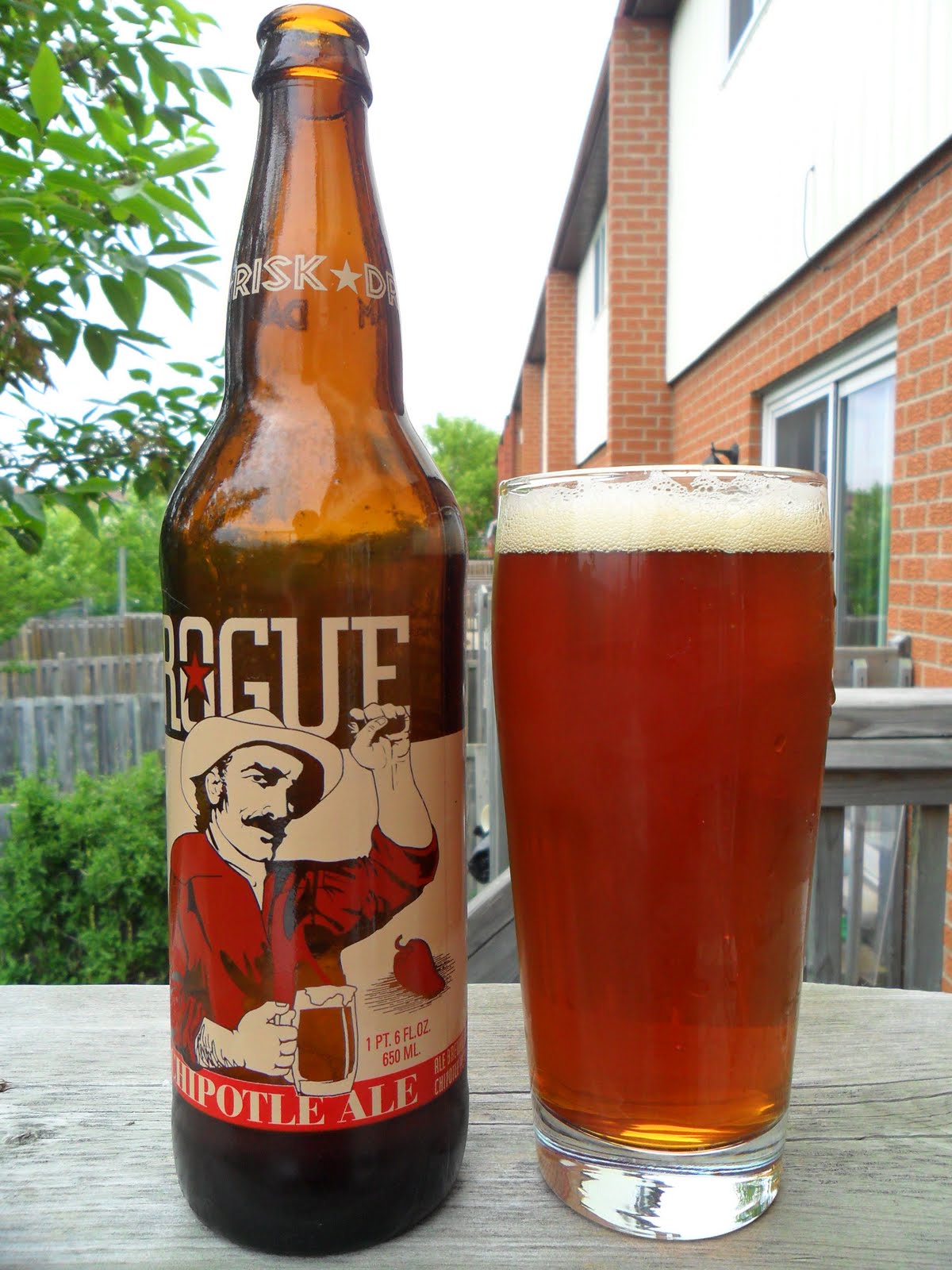
Nose is surprisingly mild. Malt, a bit of cascade hops, and what I assume to be the peppers, but had I not known what the beer's ingredients were beforehand, I would have just called it a 'astringent smokiness'. 


Chipotle Ale tastes...interesting - not in that patronizing sense of "that piece of modern art with its use of boiled panda spleen is...interesting", but that this beer is demanding my interest because there's a lot going on and I'm not sure what to make of it all. Starts off slightly malty and with a bit of an IPA feel to it, before the chili peppers rush in. The chipotles give the brew a nice peppery southwest character, with hints of smoke and leather, with the sweet malts and west coast hops cleansing the palate. Not a spicy brew; it just possesses a mix of flavors that seem to work fairly well together. As you get used to the taste, the chipotle becomes a little less predominant and it starts to taste a bit like a "southwestern rauchbier", in this observer's humble opinion.  Assertive carbonation, medium bodied, oily.

Do I like it?  I guess so.  I mean, it's not bad, but it's probably not something I'd have too often.  I tend to agree with another online reviewer that this might be a great cooking brew. While it mercifully didn't taste like someone dumped pepper juice into a beer tun and called it a day, the pepper flavor is only mild - I had expected a bit more zing to it.  Still, an fine effort. (Grade: a tentative 'B-')

Beer: Somer Orange Honey Ale
Type: Pale Wheat Ale
ABV: 5.2%

I should mention one other thing that Rogue is doing that I really appreciate, and that's their listing of the beer's ingredients on the side of the bottle.  This isn't a simple "Ingredients: Barley, Hops, Water, Yeast" sort of pithy list.  I hate when breweries have to do that, because that's what beer is.  You might as well have a winery post their ingredients as "Crushed Grapes, Water, Time."  Rogue, on the other hand, goes into far more detail, telling you exactly what kind of malt, hops, yeast strains and additional spices and flavorings have gone into their brew.  A lot of this information is probably more than any but the most dedicated beer geek would need (Rogue, for example, goes so far as to post the beer's gravity in degrees Plato* - if you aren't a brewer or supreme beer nerd, this information is pretty useless) but it still is nice to see a brewer go the extra mile.  For instance, if you find that a brew has a particular hop flavor you like or don't like,  it would be good to know exactly what it is so you can adjust your future purchasing.  Rogue has you covered on that front.

According to the bottle, Somer Orange Honey Ale, in addition to the usual wheat malts and local yeast strains, contains what should be some pretty tasty flavorings: wildflower honey, chamomile tea, coriander and orange peel.  Should be quite enjoyable. 

Poured into a fluted pilsner glass, just cause that's what I'm rocking today.   While initally a pale golden brew, my secondary top-up pour yielded a great deal of sediment, which allowed for some golden-straw murky goodness.  Some sediment patches on the bottom of the glass, good frothy head and decent retention, some lacing.

Despite all I said before about the ingredients, the nose on this brew is, I'm sad to say, surprisingly tame.  Wheat malt, honey, a bit of citrus (grapefruit and lemon).  Mild, though still quite pleasant. 

A decent wheat malt backing with a bit of crisp cracker to the finish, and surprisingly subtle notes of of honey, flowers, lemon and tea.  To be honest, such bold and exciting brews as the Brutal IPA and Chipotle, I have to say I was a little let down by the Somer Orange.  Though, refreshing, tasty, and certainly enjoyable, the flavors were pretty underwhelming - I really expected a lot more from this brew.  All the flavor notes I so anticipated from the label were barely present, and involved some genuine hunting - and hopefully nothing imagined or made up - on my part to detect them.

Tasty, yes, but certainly nothing worth getting as excited about as the girl on the label seems to be (although based on the label, it looks more like she's drinking a stout or dark IPA, which I think would be much more worth celebrating).  Perhaps the pale wheat ale is a style that I don't really care for, or maybe my expectations were too high.  In either case, this was my least favorite of the four, but don't take this point too far - it still is a decent brew.   (Grade: B)

Beer: Captain Sig's Northwestern Ale
Type: American Red Ale
ABV: 6.2%

Finally, we come to Captain Sig's, a brew named after the Sig Hansen, the deep-sea crab fishermen whose exploits are the subject of the Discovery Channel's Deadliest Catch. 

Poured into a conical Flying Monkeys glass in honour of the hoppy communion I am about to receive. A sludgy, muddy coloured brew, not entirely unlike the underwater silt in which one might possibly sift for crawfish. Sandy sediment on the bottom of the glass. Not the most visually appealing beer, but certainly a quality head and excellent lacing and retention.

And thus end my criticisms of this beer.
The nose is a brilliant mix of juicy, leafy, citrussy West coast hops and delectable caramel malts.  Outstanding stuff.

Northwestern Ale tastes like a citrussy and bitter IPA, but possesses the earthiness and richness of a red ale; the dark murky colour firmly places this brew in the Red Ale camp.  Each sip yields caramel malts up front, transitioning to that lovely blend of earth and citrus, leaving a long, citrus and biscuit finish.  Lighter carbonation, thick bodied, slightly gritty or silty from the sediment.  A beer you can really gnash your teeth on.

A highly enjoyable brew, hearty and full of West Coast goodness. Will be back for more of this ere the release is complete. Great stuff! (Grade: A-)
-

All in all, an excellent lineup that provides a solid introduction to the Rogue brewing tradition.  Diverse as these brews might be, a look at the brewery website or the Beer Advocate listings shows that this is but a small fraction of the brews that are currently available from Rogue, though it is unlikely that we'll see too many others in Ontario, unless the ones that are part of this release start to fly off the shelves.   Definitely the price point might seem a bit daunting (around $6 for a bomber at the LCBO), these brews are certainly worth a try, especially if you're looking to satisfy your West Coast hop cravings until Smashbomb makes it onto the shelves - according to the Flying Monkey's facebook group, they are brewing their LCBO batches as we speak!

Sunday, June 12, 2011

Owl Beer

Like many a country, Japan is not one that is typically well known for their beer brewing expertise.  If you're like most North Americans, I'm willing to guess that your only experience with Japanese brews are those pale "rice lagers" like Asahi and Sapporo that are available at every sushi restaurant to provide that authentic Japanese experience, and I would certainly be in that boat.  I'm not averse to a nice dry brew when eating raw fish, but there really isn't a whole lot to distinguish these beers from anything else.  For a country so well-known for its cuisine, tea and distilled spirits, surely one can expect better things from Japan.  One would be right. 

Mercifully, this spring the LCBO has brought in this lovely little witbier from Kiuchi Brewery, giving those of us a mere sampling of the potential for greatness one should expect from a Japanese craft brewing industry, small though it might be.  According to Kiuchi's website, the brewery began in the mid-19th century just prior to the Meiji Restoration, when Japan centralized its economy and social structure around the emperor, rather than the loose confederation of shogunates.  As one might expect, Kiuchi was originally a sake brewer; a close alliance with the new Meiji emperor and smart business practices at the time of the post-Second World War economic boom allowed the brewery to carve a nice little niche (or "nest"?) for itself.   Check out the website; the brewery looks like something out of a Kurosawa film - it really must be beautiful to visit.  In 1996, the brewmasters turned their attention to the brewing of ales as well, and not of the pale rice lager variety.  Hitachino Nest White Ale was first off the shelves, a wheat ale brewed in the Belgian tradition using coriander and orange peel, and with an adorable little owl character on the label.  Other brews in the Hitachino line followed, flavored with American-style hops but staying true style-wise to their Japanese roots, such as their Hitachino Rice Ale and Ginger Ale, the latter having among the most bizarre beer labels I've ever seen (though it's par for the course for general Japanese weirdness...)

The Hitachino Nest White Ale remains their most popular brew, and certainly has been among the more readily-available of Kiuchi's brews outside of Japan since they began distributing to North America in 2000.  (Indeed, many beer lovers living in Japan have lamented that it can be easier getting Kiuchi brews in the United States than in Japan...good old distribution logic...)

Thanks to Jay and Lori for picking up a bottle of this for me - I really enjoyed it, though sadly, I was unable to determine what kind of owl they used in the brewing process...


Beer: Hitachino Nest White Ale
Brewery: Kiuchi Brewery (Naga, Japan)
Type: Witbier
ABV: 5%

Sorry for the poor pic - it was in the evening and the glass was a bit dirty.  Hitachino pours a pale, hazy yellow-golden, almost the colour of white grapefruit juice. The head didn't last too long, unfortunately, but based on others' reviews I've encountered online, this clearly was my fault.

Nose is a lovely citrus blend of orange, grapefruit and lemon, some herbal and floral hops, and a nice yeast/wheat malt backing. One of the better aromas I've encountered in a wit, and that includes brews from Belgium proper.

Very juicy and remarkably flavorful. Truly, this is one of the most satisfying witbiers I've encountered in some time. Ridiculously thirst quenching, and certainly a prime candidate for the ultimate breakfast/brunch brew. Citrus (orange, sweet grapefruit) and malted wheat in the front, some splendid hopping (floral, herbal) to the finish. Great stuff.

Thin bodied, tart, zippy carbonation.

If I ignore all those big-name rice lagers, I can fortunately claim this to be my first real beer from Japan, and what an entry this was. Were the price a touch lower, I'd drink this all summer; as it is, I'll at least try to keep coming back to it.  Pound for pound, this is one of the best witbiers I've ever encountered - truly great stuff! (Grade: A)

Tuesday, June 7, 2011

More Australia Brews!

Sorry for the long delay in posting guys.  Going through a long stretch of home renovations and trying to get the house in order after being gone for a month.   To keep things rolling, here's a few of the more interesting beers I encountered in my Australian travels:

Beer: Barons Lemon Myrtle Witbier
Brewery: Barons Brewery (Woollahra, New South Wales)
Type: Witbier
ABV: 4.5%

A single bottle picked up at a Canberra liquor store.  Certainly picked this one up because of the name; anything smacking of lemon myrtle can't be all bad, right?  Talking to folks later, I found out Barons is a bit of a style-over-substance type of brewery.  Although they have some interesting-looking stuff on tap, there's nothing overly exciting, save for this fellow.  Ah well, let's give it a go anyway!

Poured into the closest approximation to a beer glass I could find in our Canberra apartment.  Poured a pale golden straw colour, which was initially clear and sparkling but the swirling of the sediment yielded a nice opaque consistency. Good frothy head, lots of lacing.

Nose is lemon, herbs, grass, a bit of soft wheat malt.

A good beer rule of mine is that whenever a brewery goes out of its way to identify the dominant flavors in the beer's name ("chocolate stout", "orange peel ale", "ginger wheat ale"), it usually means that those flavors will be overly potent, and will probably crush the beer's delicate balance.  This was certainly the case here. Although this was a fairly tasty brew, and would no doubt enjoyable on an autumn patio, the lemon flavor is a bit artificial tasting, and was far too overpowering.  Still, lemon is a nice flavor to have in a beer, so I still enjoyed it.  Finishes with a grassy hop kick to cleanse the palate. Slightly creamy, zippy carbonation.

A decent witbier, a bit heavy-handed with the lemon flavor, but still nevertheless a good warm weather drinker.  (Grade: B-)

Beer: Feral Hop Hog IPA
Brewery: Feral Brewing (Perth, Western Australia)
Type: American IPA
ABV: 5.8%

The second brew from my excellent Australian beer trade (cheers again, David!), enjoyed on a quiet evening in Sydney before we headed out to sample the night scene.  When my Aussie friend asked me months ago about what kind of breweries I wanted to try for when I arrived, I responded that I'd be game for anything - although I have to say I certainly was hoping for something from Feral.

Feral is one of a several exciting new microbreweries from the state of Western Australia, which offers a wide variety of ales and lagers with a distinctly American bent (in the brewing world, this is very much a good thing), as well as a respectable sampling of Belgian and English styled ales.  Of their list, Hop Hog is among their most sampled and highest rated (according to BA and RateBeer), so you might safely call this their flagship brew.  It certainly tasted like one, as we shall see!

Poured into the handy hotel room tumbler glass, which served its purpose admirably. An amber-russet brew, slightly hazy, with a lively head, great retention and lovely icicles of lacing. First rate appearance.

The nose is solid American citrus hops, brown sugar, pale malt. Some orange, lemon and other tropical fruits kicking around.

A maltier American IPA, with the hops coming to my attention only later in the sip. The hops have a nice earthy character with the citrus only mildly poking its head above the surface. Quite flavorful, although the hops lack that juicy punch I come to expect from any brew with "Hop" in the name.  Still, quite tasty and enjoyable.   Effervescent carbonation, medium feel.

With a bit of tweaking, this IPA could hold its own quite nicely against other brews of the style.  I guess you could say we're pretty spoiled with IPAs in North America (less so in Canada), so our expectations can run a bit too high; I certainly thoroughly enjoyed this brew!  Hop Hog is a highly drinkable, approachable IPA and is well-worth seeking out - if you can find it, that is... (Grade: B+)


Beer: Knappstein Reserve Lager
Brewery: Enterprise Brewery/Knappstein Winery, (Clare, South Australia)
Type: German Pilsner
ABV: 5.6%

For all my drinking exploits in Australia, I have to say I really didn't spend much time sampling their world-famous wines and visiting their undoubtedly scenic wineries.  Which is a shame, really, because I'm sure a winery exploration of southeastern Australia would have been fantastic.  Now I likes wine and I likes it fine, I've just never been able to distinguish one wine from another enough to really worry about which wine to have, so I've never really progressed beyond the confines of: "I like that wine.  That one is too dry.  I detect berry and oak, possibly some booze.  Further sampling is needed...you know what, just leave the bottle."   That, and as a dedicated quaffer of the ale, I tend to harbor a bit of resentment towards wine, because it has so nicely weaseled itself into a position of primacy in the alcohol-drinking world, becoming a far more cultured, sophisticated and socially-acceptable beverage than the blue-collared barley juiced swill we Delta-Epsilons so enjoy.  But I certainly have a strong respect for the vintners; indeed, anyone whose vocation is providing the lot of us with intoxicating beverages is fine with me.  And my wife and I do enjoy our yearly drive through the Niagara region, stopping by whatever winery comes up next on the GPS (there are a lot of them) and buying a random bottle or two, so I do know a little bit about wine.   I also know that those who make wine tend to also make some pretty damned good beer as well; I've sampled many brews from places whose normal produce is wine, and I've been satisfied if not ecstatic with the result.   Knappstein, being the formidable vintners that they are, have certainly succeeded in this front.  In fact, I can safely say that their brew was my absolute favorite of the trip, and once again I owe this drinking privilege to my Aussie beer-trading comrade David.

Poured a light hazy golden, clear and effervescent, sturdy inch of frothy head. Not much lacing, but excellent retention.

The nose is simply fantastic: truly, this stuff smelled like the holy matrimony of wine and beer.  Sweet white wine (Cabernet Sauvignon, I've been told), fruit (apple, passion fruit, melon, orange, grape), honey, mild grain, a bit of light hops.  The sweet alcohol smell reminded me a great deal of mead or ice wine.

Knappstein Reserve is truly an excellent lager, fresh and fruity, but with a clean hop finish to maintain its overall "beeriness." The wine flavors are terrific, nice and sweet, complimenting the malt quite nicely.  Finishes with a dry white wine kick, slightly astringent.  The beer was mildly under-carbonated, but that was probably my fault, as I subjected the bottle to a 25 hour flight back to Canada before I got around to sampling it properly.  The mouthfeel is nice and light, refreshing, with a dryness lingers on the tongue.

Simply brilliant.  Knappstein takes the best parts of a German Pils and an Aussie Cab-Sauv, making an end product that is greater than its sum.  A must try!  (Grade: A)

Beer: Seeing Double
Brewery: Brewboys (Sydney, NSW)
Type: Scottish Ale / Wee Heavy
ABV: 8%

The last brew of the trip, which, like the Knappstein, I ended up saving until I got home.  There just wasn't a great opportunity to really savour these two brews while there, and I wanted to extend the wonderful Australian brew-experience a little while longer.  I could have even aged this one a little, but lets face it, I can't risk this guy going foul without having sampled it.  A good aging rule of mine: only age stuff you've tried before, first so that you have a frame of reference to compare it to, and secondly, I could keel over before having tried it.
"Well, good night!"
  
I'm totally serious: I have no intention of dying in a freak leopard accident with unsampled beer in my cellar, dammit.  Beer is for the living!  Fortunately, since my current status pegs me at "alive", I guess it's beer time!

Scottish Ales or Scotch Ales - sometimes known as "Wee Heavies" - are exactly how you'd imagine an ale from Scotland would be: strong, malty, peaty or leathery, and totally incapable of qualifying for the World Cup.   While hops are there (mostly as a preservative), the flavor is really all in the malt, not entirely unlike a fine lowland scotch whisky.  Wee Heavies are boiled extra-long to caramelize the sugars, which makes for some strong, sweet, malty goodness; as Randy Mosher observes in "Tasting Beer", a Wee Heavy is really just a Scottish barleywine.  They were also the most expensive of the ales, using the antiquated shilling method of pricing ales.  You may have seen Caledonian 80 Shilling (80/-)on tap or in the LCBO, a nice standard Scottish Ale, which traditionally went for...you guessed it, eighty shillings; Wee Heavies on the other hand, being a more complex (and stronger brew) typically marketed for a hefty160/-.   A pretty penny, indeed, but certainly worth it.   Though not too well-known outside of Scotland, fortunately many craft brewers have the Errol Flynn approach to brewing: they'll do anything.


Poured into a nonic glass, and enjoyed on one of the more humid days I've encountered since getting back.  Not really the ideal beer for a day like this, but I really wanted to finally try it!  A rich, sludgy, murky brown brew, toffee-coloured when held to the light.  Left behind a nice sturdy off-white head, with some lacing flecks.

The nose is a pure malty delight: caramel, toffee, fresh bread, cracker, a touch of peat and leather.  Smells exactly as one would expect.

As complex as a mid-range bottle of scotch, Seeing Double sports an impressive flavor profile.  It opens with a nice malty blast of caramel, bread, biscuit and dark fruit, before settling in to a lovely dry peaty-leather finish, with only the faintest traces of hops.  The alcohol, which is quite high, is nearly imperceptible, which is a very dangerous thing indeed.  No doubt one would certainly be seeing double after a few of these bad boys.  The leather/peat character lingers long on the tongue.  Slightly creamy, light but spritzy carbonation, thicker bodied.

A great example of the Wee Heavy style, in fact I'd happily rank it alongside some of the better Scottish offerings.  A study in malt, but with a nice diversity of flavors to make for an interesting and enjoyable sipper.  Not something I'd recommend more than a bottle or two of at any given time, but certainly well worth seeking out if you're Down Under.  Great stuff indeed! (Grade: A)

-

Well, that about wraps things up from my Australia Beerventure.  Though I was a bit stymied in my attempts to try some of the more obscure brews the country has to offer, a successful grocery-store haul, some exciting brewpubs and a fortuitous trade with a fellow Quaffer of the Ale has shown me that Australians not only love their beer, their craft breweries are off to a cracking start.  From this small sampling of brews, I've seen Australia's brewmasters' reverence for the ale traditions of the British Isles, their superb ability to utilize the newer hops and brewing styles from the United States, as well as a great passion for experimentation.   Foster's and VB be damned; Aussies can brew beers as good as the rest of us - it just sucks that I have to travel so damn far to get my hands on them! 

 
Cheers!

Tuesday, May 31, 2011

Some fine drinking to be had at The Rocks, Sydney

Moving on from Canberra, we spent a few eventful days in Gold Coast, Australia's paean to sun, surf and cheezy tourist traps.   Although we caught the city in the midst of a bit of a random cold snap, rather than the 30-plus degree weather that they enjoyed a week prior, we instead were treated to far milder temperatures and rain storms that are more indicative of a tropical climate in autumn.  Nothing too exciting beer-wise in the city, but that’s to be expected.  A road trip to Brisbane – about an hour north – would have yielded a potential visit to the XXXX (Four X) brewery, but XXXX isn’t a great beer whatsoever, and based on its website the brewery looked like it was aiming for the drunken reveller crowd, rather than the discerning beer-geek.   Nothing wrong with that, it’s just that I’ve done it before and didn’t feel like renting a car.   The pubs around town carried the usual macro fare, wines and cocktails that one would expect in a tourist zone.  I certainly managed a great deal of drinking to be sure, but nothing really worth posting on the blog.  For the next great beer experience would have to wait for Sydney.

Sydney possesses exactly as much scenic beauty as I had expected; anyone who has been there before can certainly attest.  The harbours, the Opera House, the gardens and parks all contributed to a wonderful experience exploring the downtown core, and I eagerly await my next visit. Nearly every corner turned or park explored elicited a “this is nothing like Toronto and I love it” remark from yours truly.  Our hotel wasn’t too far from Darling Harbour, a trendy district of restaurants and bars encircling a gorgeous harbour front and surrounded by the majestic skyscrapers of downtown Sydney.   We tended to do most of our dining here, which was quite excellent.  Nearly every dinner special came with a free glass of wine or beer, but the beers weren’t anything special so I tended to stick with wine in the evenings.   A few pubs and eateries around Hyde Park featured the usual Australian macro lineup (as well as the ubiquitous Guinness, which I must admit tasted really strange down under).  To truly find the great pubs and beers of Sydney, the best bet is to head to the oldest district of the city, The Rocks.


The Rocks is located just west of the Opera House and sits just underneath the Harbour Bridge, so it’s right in the thick of things.  A quick walk from Circular Quay and you’re surrounded by historic buildings which take the form of restaurants and fun little shops, with an excellent weekend outdoor market taking up the side streets.  Those lucky enough to call Vancouver home might find a similar experience in Granville Island.  And, like Granville Island, the Rocks is also home to a brewpub – and a damned good one at that. 

The Lord Nelson Brewery Hotel is one of Sydney’s oldest establishments, and yes, it is a functioning hotel (though it was a bit pricey and the word is that service there isn’t terrific, especially on busy nights).   Like a true Victorian pub, the walls are stone, the atmosphere is slightly dank, and the bar is long and full of inebriated patrons.  The kind of place I like.  The Lord Nelson is naturally dedicated to the memory of England’s near-mythic naval hero, and thus the beers brewed on-site reflect the hero of Trafalgar.  With Aussie rules football on the telly, we sipped schooners of Victory Bitter (the HMS Victory was Nelson’s ship), Trafalgar Pale Ale and Old Admiral Strong Ale, all the while surrounded by images of the great naval battles of the Napoleonic Wars, which would have been fresh in the minds of the early generations of Australia’s settlers.  The bar was quite busy, preventing me from chatting with the bartenders or brewmaster, but we were served very quickly and were pleasantly satisfied with the selection on tap.   Certainly a place I hope to visit again in my next trip to Sydney.

Though not a brew pub, the adjacent Hero of Waterloo – just up the street from the Lord Nelson) – is nevertheless a historically significant and intriguing place to whet one’s whistle.    Officially founded in 1843, the Hero is named after another legend in British History, Lord Arthur Wellington – victor of the battle of Waterloo and (briefly) Prime Minister of the United Kingdom.   Since I live in the city of Waterloo, which borders the county of Wellington, the significance of this historical figure is not lost on me.  According to the blurb on the front of the menu, the pub was “popular” with troops from the Sydney garrison, and thus has seen its share of interesting stories, the most intriguing being the secret tunnel which connects the pub to the harbour front, allowing clandestine smuggling of spirits, beer, and occasionally, drunken patrons who “voluntarily” took the Queen’s shilling and were impressed into the Royal Navy.  Or so the legend goes.
The pub itself is a delightful throwback to the Victorian Era, with its stone walls, multiple fireplaces, and bar staff that seems to represent every vestige of the former British Empire – the bartenders were Scottish and Irish, respectively; the band were playing the best of classic American jazz, and I’m fairly certain one of the chefs is from India.  I’m sure if there was maple syrup and back bacon available, it would have been served just to complete the set. 
The tap list was among the better varieties I’d encountered in my travels – the usual Cascade, Hahn’s Dry and Carlton Draught lagers were of course present, along with at least three or four James Squires ales, and a couple of house specific ales.   I enjoyed a James Squire Porter and (an underwhelming) Hahn’s White, while Michelle sipped on Squire’s Amber Ale and Pilsner.  Prices were about as good as one would expect them to be; indeed, for the atmosphere and location, I’d have happily paid more.  The stone walls provided an excellent reprieve from the early autumn heat, and the band’s tunes kept the evening rolling.  It was at the Hero of Waterloo that our accents and excessive politeness ‘outed’ us as being Canadian, and a gregarious and friendly family of Aussies asked us about our travels, whether we liked the city, and how we were getting on.  But after the pleasantries were taken care of, it was time to ask the big question: “Can you say a-boot”?   Christ...  Good news, though: apparently they found our accents to be quite charming, and they just loved listening to us talk, which is about the same as Canadians feel about Australian/New Zealand accents.   Nice to know that the shoe fits on the other foot.   They told us how much they loved the Trailer Park Boys; I apologized on behalf of Canada for Justin Bieber.  A grand evening all around. 
The Rocks is truly a magical place, steeped in the history and culture of the city of Sydney.  The architecture remains distinctly Victorian, and the streets lined with shops, pubs and restaurants give the district an open-air, market feel.  These weren't the only two pubs worth visiting in the district, of course; down George Street you will find 'The Fortune of War' across the street from First Fleet Park, while those looking for a change of pace can have a stein at the Lowenbrau on Argyle.  Nestled in the shadow of the Harbour Bridge, and never too far away from the Opera House and the gorgeous waterfront, the Rocks is one of the finest places to knock back a few pints in Sydney.  Just be sure not to get too intoxicated, lest you find yourselves swabbing the deck as one of the Royal Navy's newest 'recruits.'

"FUUUUUUUUUUUUUUUUUUUU-"

Monday, May 16, 2011

The Wig and Pen: Single-handedly Making Canberra Liveable Since 1994!

Okay, okay, I know - that was a cheap shot at Canberra, and I'm not proud of it.  It's just that it's so easy to do! 

Making fun of Canberra seems to be an Australian national past-time - at least, that was the impression I got in the months and weeks leading up to our trip.   Whenever folks (Australian or not) discovered that I would be going on an epic plane ride down under, they politely asked me whereabouts I would be going.  A fair question, and I responded honestly - a week in Canberra, some beach time in Brisbane, then to Sydney for a few days.  Generally speaking, most people were polite, but almost without exception, the listener would noticeably bristle at the mention of the nation's capital.   I sometimes didn't even get to mention the second and third destinations before being interrupted: "Canberra?  For a week?...*confused pause*... Do you have family there? Business?  Or is there some other excuse for visiting what would happen if plain Quaker Oats were to morph into a functioning city?"  Even when I was in Canberra, I still felt like I had to justify my being there.  It's like the town motto was "Canberra: We have to be here, what's your excuse?"  By the end of the trip I decided to skip the inevitable line of questioning.  When folks asked where we'd been so far, I just responded: "Canberra.  Visiting family.  For Easter weekend."  And that usually satisfied them, but even then I wasn't sure.

Part of the problem with Canberra is that its a planned capital, designed and build specifically to be the nation's capital.  In fact, Canberra owes its very existence to the fact that Sydney and Melbourne don't really like each other.  If you think of Australia like a mob boss (and I encourage you to do so!), Sydney and Melbourne would be like the feuding, spoiled bratty sons who spend all their free time squabbling over who gets to be in charge when daddy shuffles off.  Realizing that giving the responsibility to one son would lead to years of feuding and casual name-calling from the other, the wise old Don decided to skip the whole process and raise an orphan from scratch, eventually putting him in charge.   Now imagine this new orphan is kind of lame, very business-like, wears a suit all the time - if it were Mad Men, he would be far less like Don Draper and far more like that married guy with the bow tie and lollipop - and there you have Canberra in a nutshell.  So the city is new, clean, a bit boring and lacks an interesting history - couple that with the fact that it's the home of the nation's government, and thus the target of the nation's ire - and you'll pretty much understand why most Australians seem to be less than proud of their capital city.

But I'll say it without shame - I actually liked Canberra.  Now, I'll admit that if I were to actually live there, the city would probably get a bit boring after a while, and Canberra does have that worky-work-work feel that downtown Toronto does, but then again, most cities are pretty lame - it's only a select few that have anything interesting going on.   Canberra was clean, well-organized, quiet, had some lovely parks and gardens, and the people were generally quite friendly.  Because of the parliament buildings, national museums and galleries, Canberra nicely satisfied my need to see "official" things when I travel, freeing my conscience to visit the more kitschy, touristy attractions elsewhere.   And because I'm a history nerd, I quite enjoyed visiting Parliament and the other major governmental places, especially the War Museum and ANZAC memorial.  I could figure things out without too much problems, there seemed to be a lot of restaurants, bars, and a pretty damned big mall.  

And above all, Canberra has the Wig and Pen, and that's sufficient awesomeness to shore up any city's flagging reputation.  This place was awesome.


When I put forward the question to some Aussie beer-lovers online as to where I should partake in the finer ales in Canberra, the answer was loud and clear - the Wig and Pen, no question about it.   And dammit, they were right.   Founded in 1994 by a microbiologist by name of  Lachie McOmish, the Wig and Pen is a beer-lover's wet dream.   All the brews available on tap are made on site, and without exception, they were fantastic.  Four cask taps, three seasonals, about eight regular offerings, and three one-offs - all for about the same price you'd pay for a drab Australian lager down the street.
Brewing tuns visible in the back window.

The place is a real anomaly in the neighborhood, tucked away in a generic shopping building near nowhere in particular and surrounded by office buildings of an officious and governmental nature.  Not where you'd expect to find a brewpub, at any rate, but fortunately, it was only two blocks from my apartment so it was a real treat.

It has a lovely green English pub exterior with patio seating for about 20, and a small, cozy interior for about 80-100.  It also had the kind of atmosphere I like: simple seating arrangement, wood-paneled bar area, friendly beer-loving patrons.  And no TV that I could see - this was a social spot to be sure.  I went both times in the afternoon and it only really felt crowded around 5ish, which is understandable.  Brewing equipment is visible from your table if you sit near the back, as we did.

The bartending staff were quite friendly (a bit of an anomaly in Australia as well), and were quite willing to let you think your selection over without feeling slowed down.  They also handled an uncooperative cask tap with equal patience.  The day bartender was quite affable, and enjoyed talking brews and footy with me. I met the brewmaster, Richard, for a quick moment, and found him to be the pinnacle of Australian modesty and self-deprecation, as he only hoped that I was able to find "something in the lineup I could drink." I assured him I certainly had.
A snifter of Bob's Armpit.

The lineup is quite diverse, ranging from English real ale, Koelsch, wild ale and oatmeal stout.  Not a pedestrian brew in the bunch, and generally speaking all of which are very well-brewed.   I personally recommend their Lazy Days cask ale, Velvet Cream Stout (which tasted a great deal like McAuslan Oatmeal Stout), Bob's Armpit (a lambic-wild ale one-off concoction) and the Kamberra Koelsch. Tucked away I could see a fine little Australian and Belgian bottled collection as well.

Certainly the place to hit up in Canberra, the Wig and Pen was one of the real highlights of my trip.  Great home-brewed selection, friendly atmosphere, the Wig and Pen is a real exception from the general city-wide trend of crowded pubs full of Australian macros and Guinness. A real refuge for those who love craft brews.  A bit pricey, but only slightly more so than the other places around town; consider what you're getting quality-wise on tap, and I think an extra dollar a pint is more than acceptable.  My only suggestion for the pub is that there be some sort of sampler option for folks like yours truly who just want to dive right in and try everything on the menu. 

So if you find yourself stuck in the city of Canberra, don't lose heart - a fantastic brewpub is right around the corner that will certainly make your trip worthwhile.

Cheers to the Wig and Pen!

Sunday, May 15, 2011

Australian Brews! - My Favorite Beers From My Trip Down Under


Sorry for the long delay in posting, but even I get to have a vacation every once in a while.

So as most of you probably know, I got back Wednesday last from a fantastic trip to Australia.  It was a truly wonderful experience.  Australia is certainly a beautiful country filled with lovely, genial people, many of whom expressed deep admiration for our delightful accents (good to know that the shoe fits on the other foot as well!) and insufferable politeness.  I found Australians to be a very cheerful, unassuming bunch, whose nation's history shares some striking similarities with that of Canada, so I found we were able to fit in quite easily - once we figured out their baffling coffee drinking system ("Flat white? What the hell is that?").  Unfortunately, my likelihood of visiting that lovely country again in the near future is not very likely at all, as the fates have conspired to stick Australia as far as humanly possible from me to prevent regular travel.  Such unique beauty and ecodiversity diversity comes at a price, it seems.  It's been over a week since I returned and I am only just now starting to recover from the jet lag.  Seriously, that long flight and time difference really cuts into one's beer drinking.  Fortunately, I'm more or less back to my usual dynamic self and am ready to regale you all with tales of beergettery and beerdrinkery!  Let's get right to it!

"Let the booting begin!"
First, a word about drinking beer in Australia.

Unlike the Socialist Republic of Ontario, Australians have privatized liquor stores, which would be cool if it weren't for the fact that - as the LCBO correctly reminds us - the selections at the corner store booze chains tend to be pretty lousy.  We went in to about seven different stores and generally found the same beers in each one, and none of them were particularly inspiring.  Well, I shouldn't say that, as there were a few places that seemed to have a better variety of brews than others.  But almost nowhere had the kind of selection of craft brew bottles that we come to expect in Ontario and demand in the United States.  Not that I was expecting some sort of craft beer mecca on every block, but an occasional thrown bone would have been nice.  I asked a fellow beer-lover from Australia about it, and he seemed to suggest that distribution is quite a problem, not just for imported crafts (which is understandable - Christ, that was a long flight...) but even from breweries within Australia.  Other than a few of the bigger craft breweries like Fat Yak, James Squire (Malt Shovel) or Barons, you were hard pressed to find more than a few other out-of-staters, in your local shops, if they carried them at all.  Strangely enough, the best locations to get craft brews - at least, from what I could find - were the grocery stores, which had pretty solid selections of single bottles and six packs.  I managed to get most of my initial haul, seen here, from a Supabarn grocery store in Canberra (a few are courtesy of an in-country trade with my aforementioned beer-loving friend), but could find almost none of them anywhere else.  Neither the Gold Coast nor downtown Sydney seemed to have any bottle shops that carried anything other than the usual Australian big brand stuff.  Clearly, privatization doesn't necessarily equal better selection.  For the rest of the trip, tracking down craft brews proved to be exceedingly difficult.


Yet one positive to Australia's global isolation was that I couldn't find Budweiser or Coors Light on tap or in bottles anywhere!  I couldn't believe it!  It was so glorious to be far very away from these American brewing behemoths, because I'm so sick and tired of going to bars and restaurants in North America and finding these flavorless poor excuses for beer clogging up the taps.  To be fair, the stuff that was on the taps wasn't that much better (all Australian macros, like VB, Toohey's, Hahn Extra Dry and Carlton Draught), but at least they were Australian.  It truly was very refreshing to have such a reprieve.   

A half-pint (middy) of James Squire Amber Ale,
and a witbier schooner of Hahn White.
Most pubs tended to have the same general lineup on tap, although there are many great brewpubs to be found, and the two I managed to snag a pint or two at will be explored in the next posting.  Aside from featuring VB, Toohey's and the other usual Australian lineup (no Fosters, that's an export brew), fortunately nearly ever pub I encountered had at least one or two brews that worked well as standbys.  Almost every place I went to had either Fat Yak Pale Ale or one of the James Squire line of brews.  I think it helped a great deal that Australians love their beer - more so, I would argue, than Canadians do.  Pints, pints, pints, everywhere you went.  Even at the trendier, clubbier pubs, men and women alike were still almost exclusively slugging back brews.  Only a few folks were sipping wine (which seemed to be more of the with-meals beverage), and only the loudest and most obnoxious girls were having cocktails - and at an average of $15 for a mixed drink, I'm not really sure how well they (or the prospective males) can afford it.  Perhaps this love affair with beer means that more places are capable of carrying more than just the lowest common denominator brews, and could offer a few alternatives to the non-lager drinking folk.  And with only Guinness, Stella and Heineken as imports, you can easily have an enjoyable night drinking nothing but Australian-made stuff. 

Now that you've picked your brew (which is done and paid for at the bar, not by sitting lazily at your table), you have to pick your size.  Australians usually have three sizes of glass to pick from, with different names for each depending upon your region/upbringing.  In New South Wales, Canberra and Brisbane - the three cities I stayed in - a pint is, well, a pint, as it is throughout the country.  You could also order a half pint, or 'middy' (also known as a 'pot' in Victoria), just under bottle-size at 285mL, which was great for sampling multiple brews in a sitting.  I went with the middy-sized glasses at some of the brewpubs to maximize my tasting potential.  Slightly larger is the delightful schooner, which is great for those situations whereby a pint just is a bit too much.   I usually found myself in this camp, as drinking slightly smaller volumes allowed me to consume more varieties of beer at each establishment without getting full (we were touristing too...)  Another far less common option is the "seven" glass, which is...*drumroll*...exactly seven ounces, no bigger than a beer festival tasting glass, really.  Good I suppose if one is driving, or just has time for a quick whistle-whetting, but I didn't really see it that often.  Prices seem expensive at first, but when you consider that tipping is rare (their servers make a living wage, usually in the 20-25 $AUD range) and that taxes are included in the price, it actually ends up working out to the same amount you'd pay in Ontario.  Since the Aussie and Canuck dollars are pretty much identical, this was a good thing.

So, now that we've covered the basics, lets have a look at some of my favorite brews from Down Under.  As in Canada, I tended to find that most brews were pretty decent, a few stood out far above the rest, and some, well, you'll see. 

Beer: Little Creatures Pale Ale
Brewery: Little Creatures (Perth, Western Australia)
Type: American Pale Ale
ABV: 5.2%

My first real Australian brew of the trip, picked up at that Canberra supermarket.  Apparently, for many Australian beer-lovers, Little Creatures is somewhat of a "back-up" or "fall-back" brew - something that is somewhat widely available and tastes better than most of the other dreck on tap (Creemore fulfils this role for me on most occasions, as does Sam Adams Boston Lager).  Sturdy and reliable.  I actually found this brew to be a cut above such definitions and was very satisfied with the end result. 

Little Creatures is a nice golden-amber brew - sitting firmly on the 'pale' end of the pale ale spectrum - and sporting a half inch of sturdy creamy head.  Good retention on that, and some great lacing streaks as well.

Nose is nutty malts, caramel, citrus (orange, lemon), mildly bitter hops. 

Since the definition of 'American' vs. 'English pale ale depends more upon the hops than of anything else, and since those lovely citrus American hops are more readily available for brewers to incorporate into their products, it's not uncommon to find both English and American hops in the same brew.  Thus it can be quite difficult to categorize a brew as one way or the other on taste alone.  Now I myself would place Little Creatures somewhere between the two styles, as it reminded of either a mild American pale, a or citrussy English pale.  But no matter how you categorize it, the bottom line is that this is a great-tasting brew: accessible and refreshing, yet full of flavor.  Opens with a nutty, caramel malt flavor, then transitions to a mild citrus/bitter hop finish.  Creamy, slightly watery, soft carbonation (though not flat by any means).

Great brew, something I'll certainly come back to again whenever I'm Down Under. Drinkability is very high - easy to quaff, flavorful enough to sip, several in one go would be ideal.  I would have gladly consumed bucket-loads of it had I found it in more of the pubs, but sadly, I never encountered it again.  But I know it's there! (Grade: A-)

Beer: Wild Thing Imperial Stout
Brewery: Murray 's Craft Brewing (Bobs Farm, New South Wales)
Type: Russian Imperial Stout
ABV: 10%

Thanks to the favorable position of Australia in the global time arrangement, the Royal Wedding mercifully took place at prime time, rather than at quarter-to-stink in the morning in Ontario, which meant that, unlike for all but the most dedicated Canadians back home, Michelle and I could drink during the ceremony.  Which we did.  Since the grand proceedings were such a throwback to the glory days of King and Empire, I felt that any brew worthy of celebrating such a momentous occasion should also be suitably imperious in nature.  Also, preferably, full of booze.   Wild Thing Imperial Stout fit the bill on both counts.

This bottle was courtesy of a fellow beer-lover from Canberra, and the result of a terrific beer trade.  Cheers to David for such an excellent brew; I hope the Wellington Imperial Stout was just as enjoyable for you as this was for me. 

Poured into a red wine glass that just happened to be kicking around our hotel room in Gold Coast.  I brought it out of the fridge to warm around the time that William and Harry arrived at the Abbey, and finally opened around the time that Churchy McChurch got things going.  The brew poured a deep near-black, and left a thin mocha head that receded to a fine ring which made some nice sheets of lacing.

Nose is dark coffee malt, cream, currant.  All the best things I look for in an Imperial Stout.

Wild Thing is one rich, tasty stout, with big (and hearty) dark coffee, chocolate, cream, and dark fruit flavors, with a slightly boozy, sherry finish.  Just the right brew to make it through what it turning out to be a long, boring, churchy ceremony.  Very glad that I didn't have to get up early for this, because I couldn't watch this sober, no matter how hot Kate looked.  Creamy feel, thicker bodied, zippy carbonation.

A fine RIS, certainly worthy of special mention from OZ.  Had I been more patient, a few months of cellaring would have really done wonders for this brew, as it still came out a touch too hot.  Rich, flavorful, a great slow evening sipper.  (Grade: A)

From the highest high to the lowest low we go...

Beer: Melbourne Bitter
Brewery: Carlton and United (Melbourne, Victoria)
Type: Adjunct Lager
ABV: 4.9%

Those who follow the blog will know that I tend not to harbor any particular ill will towards any specific brewery, a stance I try to abide by with only a few notable exceptions.  Now there are many breweries that I don't really like, but this is just my personal opinion based on repeat sampling.  Though their beers might be bland, poorly-made or over-hyped (and sometimes all three), since I can't really say they've personally inconvenienced me or ruined my drinking experiences, I really don't care what they do - I just won't drink their beer.  And that's okay, as everyone has personal tastes and sometimes whole breweries will go against them.  But it takes a special kind of douchery for a brewery to warrant a personal hatred on my part, such that not only will I never drink their beer ever again but that I also will specifically wish their company to fail outright, and will attempt to facilitate this failing by deterring friends and associates from purchasing their wares.   Carlton and United, thanks to their deceptive advertizing and insultingly terrible products, have successfully added themselves to this unfortunate list, and I thus encourage everyone to avoid their brews at all possible costs.
Carlton and United brew many different beers, but they are mainly known for three of them - Foster's, Carlton Draught, and Victoria Bitter.  Foster's has been Australia's official representation on the international beer scene for years, but for some strange reason hardly anyone drinks it in Australia.  A true export beer, Foster's almost exclusively marketed for international consumption (it's one of the highest selling beers in Britain, so don't let anyone tell you they drink better beer there), and sure enough, I almost never saw it on tap or in cans.   Their real big domestic sellers are Carlton Draught, a fairly safe, bland and inoffensive lager (and the source of some pretty damned funny beer commercials, like this one), and Victoria Bitter, which is lovingly referred to by its detractors (like yours truly) as VD.  While Carlton Draught is somewhat drinkable, Victoria Bitter is one of the foulest beers I have ever consumed.  It's really something else.  I've had it in cans, bottled and on draught, and every time that I've done so I seriously regretted it.  Even 18 hours into my flight home, I could barely stomach the free can offered on the plane.  But there are certainly many other lagers out there that elicit the same response; VB is the target of my particularly potent ire because it has decided to call itself a "bitter."  When I first found Victoria Bitter in the LCBO, I was ignorant of the evin contained within.  I saw "bitter" and "Australia" and my tastebuds steadied themselves in anticipation of a delightful malted hoppy treat.  I was disappointed beyond consolation.   So let's make one thing clear: Victoria Bitter is as much a bitter as Alexander Keith's is an IPA.   Real bitters are pale ales, and contain malted barley, hops and flavor; VB is a pale lager that tastes of corn and tin and failure, wrapped in a label that would not feel out of place in the engine oil section at Canadian Tire. 

Fast forward to the corner store in Canberra, three weeks ago.  I see a bottle on the shelf.  It says Melbourne Bitter.  My stupid brain doesn't remember, or chose to forget, the awfulness that transpired before.  You see where this is going....
"We didn't listen....*sob*...WE DIDN'T LISTEN!!!"
Poured into a small tumbler.  My first clue that I had horrifically erred in my purchasing decision was the colour and appearance of this brew, which is all macro lager, and as far away from a bitter as one could ever get.  Pale golden, loads of visible carbonation, thin soapy head.  To call it "uninspiring" is an understatement.   Even though it looks like a lager should, when a beer decides to call itself a 'Bitter' I can't help but be disappointed when it looks like pee. 

Nose is almost non-existent - pale malts, a bit of lemon, chemical.  Smells like Bad.

My first sip from the bottle reminded me of those first sips of beer from my dad's nearly empty bottles when I was a kid.  Not a good sign.  The taste of the poured out stuff was not much better, just a macro lager with a foul, chemical character that made me regret all the decisions in my life that had led me to this point.   Hard to finish.   Thin-bodied, harsh carbonation.  Yellow fizzy water.  Blegggggghhhh....(Grade: D-)

Alright, this depressed me - we need to end on a high note, we do! 

Beer: Coopers Best Extra Stout
Brewery: Coopers Brewery (Adelaide, South Australia)
Type: Extra Stout (higher ABV for export)
ABV: 6.3%

Coopers is an Australian beer name you might have seen before, as their Sparkling (Pale) Ale has graced the LCBO's shelves on occasion.  I was very happy with the Sparkling Ale, but wasn't too impressed with their standard Pale Ale when I had it on draught in Canberra, so I wasn't too sure what to think about this extra stout I picked up in Sydney.  All fears were allayed with my first sip of this flavorful gem, which proved to be a most enjoyable companion in the evenings when I settled down to watch some footy (that's Australian Rules Football to you!).

Poured into the tumbler the hotel room had kicking about. Deep chestnut, almost black, with a mocha head which recedes quickly with snappy bubble bursts. Some lacing sheets.

The nose is quite pleasant: coffee, cream, milk chocolate, toasted malt, a bit of booze. 
A pleasant stout that does what it sets out to do quite well. Begins nice and malty with that sweet chocolate creamy flavor, then transitions to a dry, bitter roasted coffee finish. Quite enjoyable.

Carbonation is a bit hot, but the body is slick n' thick - just right for the stout.

A solid brew and a pleasant evening sipper. Nothing out of the ordinary, but everything seems to be put together properly.  A stout you can order with security knowing you won't be disappointed.  Also, because it's quite a bit milder than the Wild Thing Imperial Stout, its probably something that will taste great in quantities (as good as Wild Thing was, I doubt I could handle more than a bottle in a single sitting).  Great work from Coopers!  (Grade: B+)

 *****

Still lots more to come from my Australian beer adventure, including a closer look at some more bottled Aussie brews, a spotlight on two great pub districts, and a damning indictment of New Zealand Pure Lager!  Stay tuned!