Monday, March 28, 2011

Toronto's Bier Markt - Neat Spot, But Your Wallet Will Hate You For It.

Though my usual haunts in KW generally give me a good opportunity to try local/imported brews at decent prices, to really get a better feel for what's available in Ontario, one really must make a sojourn to the Centre of the Universe.  Toronto has some truly excellent brewpubs and beer bars to choose from - I've spoken very favorably of C'est What in the past - which have some great tap selections, although they can be a deal pricier than what we see out in the sticks. 

One of the spots I was hoping to check out - among many others - is the Bier Markt on Esplanade, a few blocks east of the ACC and just off the Gardiners at Jarvis.  A great location, to be sure.  Those who have mentioned the Markt rave about its massive tap and bottle selection - it's website certainly does so as well.   A good location and a large draught and bottled beer selection?  I'm game! 

A chance trip to T.O. this weekend gave me the opportunity to check the place out, and generally speaking I was happy with the experience, but with some strong reservations.

The bar was easy to find, and there is ample parking in adjacent lots nearby. Though it was dinnertime on a Sunday, the place was relatively busy.  It certainly had more than the minimum-required quorum of pretentious, suited-up Toronto business douchebags (anyone from "out West" would have had a field day with this slice of T.O. culture), but they generally kept to themselves.  The staff were helpful almost to a fault. We were welcomed in with gusto, and were brought to a good seat in full view of the bar.  Our waitress in particular was very friendly, patient (two of our party needed a good ten minutes to whittle down a beer selection, and I wasn't much better), and her descriptions of some of the more unknown brews on the bottle list were spot on.  She and the bartender were sure to pour every pint into its proper glass (it seemed like every brew on the menu came with its own branded glassware - cool!), and poured every bottle into an appropriate equivalent.  Our waitress's pouring skills were first-rate, as she made sure to swirl the bottles at the end to get the sweet sediment within.  Nice to know that the staff care a great deal about their beer, as they should!

The restaurant/bar is pretty large, dark, with stone walls and dark wood accents. Random kegs are found in piles here and there, probably as a decoration.  Some Bruegel-style paintings adorn the wall, with medieval characters imbibing ancient Flemish ales and generally looking pleased with themselves.  With the lighting and music, it felt more like a club than a biergarden, but it was still fairly nice.  We left just before the live music began.

The staff was great and the place looked good enough. However, I'd rate this place higher if even just one of the three following things had been better:

1) Beer selection: This place does indeed have a very large draught selection, far better than most places I've seen in the province, but there wasn't a lot there that really wowed me. All but a few brews on the list are available in regular rotation at the LCBO, and although it was nice to see them on draught, they were pretty standard fare - there just happens to be a lot of them.  Their draught lineup was very foreign lager- heavy, although there were some nice rarer brews to be found in the mix, and there was a healthy contingent of German wheat beers as well.  I had Spaten Munchner Helles and De Koninck Amber on tap that night, while Fuller's ESB and Denison's Hefeweizen were also tasty options I had considered.  The local brews were unfortunately wanting: just Steam Whistle, Denison's and Welly Dark, possibly an Amsterdam blonde in the mix.  Despite being surrounded by craft breweries, there was nothing from Mill Street, Granite, Duggan, Black Oak or beyond.  C'est What is just down the road, and is a lot better for this.  However, I'd have been be happier with the selection this if it weren't for...

'Verboden Frucht' ("forbidden fruit") is brewed by the same
 folks who make Hoegaarden.  This was a very tasty,
strong Belgian dark ale. The nose on this was brilliant:
figs, raisins, black currant and sherry. 
A perfect dessert beer.

2) The Price: Now to make one thing clear, I know Toronto beer is more expensive than other places, and I'm certainly not above paying a bit more for location and beer diversity, but this was pretty rough.   Even the pints on 'special' were pushing 8 bucks before tax/tip.  Bier Markt has a massive selection of single bottle selections that was so tempting, but were about 10 bucks a pop, usually more.  I splurged and had a bottle of Hoegaarden Verboden Vrucht, which was excellent, but still was about $9.50.  It was also my third bottle choice, as the previous two were out.  The prices made it really difficult to really sample the fare - I felt I really could have only have one or two before my wallet gave out.   Yes the selection is big, but you can get a lot of these brews elsewhere for far less.

3) The Food.  Holy mother, this menu is pricy.  I mean ridiculously pricy.  My wife ordered a cheese platter to accompany our sampling, and for $17 dollars we got three small wedges, barely enough to share, with a few grapes and some crackers.  Yes, cheese is expensive, but come on... Everything else on the menu was ludicrously expensive, so we took our hungry stomachs next door to a pseudo Irish pub (Fionn McCools) and ate there. 

The Bier Markt is certainly worth visiting every so often, especially if you've got a hankering for a rare foreign brew that would otherwise require a trip to Belgium to acquire.  But if the prices were more reasonable, if the food was better-priced and more diverse, or if the beer selection was more unique, this would have been a truly exceptional beer destination.  As it stands, my beer hankerings will probably take me to other places in the area.  My wallet and inner beer geek will probably thank me...

Friday, March 25, 2011

Muskoka Summer Weiss - An Early "F-You" to Old Man Winter

Beer: Muskoka Summer Weiss
Brewery: Lakes of Muskoka Brewery (Bracebridge, ON)
Type: Hefeweizen or Pale Wheat Ale (hard to tell)
ABV: 5%

It's as if the folks at Muskoka heard all of Ontario cry out in terror and then were silenced by the latest angry blast dished out by old man winter.  Those who have lived in the province for an extended period of time will know that that first heatwave associated with spring is just a ruse, a carrot on the end of the string meant to trick us into a false sense of security.  I foolishly put away my winter boots and brought out the barbecue; I was wrong.  Waterloo got the worst of it, packing in some 23cm of the non-Colombian white stuff; my arms are still tired of shoveling.   But out of the cold, aneurysm-inducing storm there was a beakon of light, a symbol of all that is good and wonderful about the world: a summer-style wheat beer, impeccably timed to be released just as the storm hit.  A wonderful reminder that better days are ahead, that we no longer need to fear winter.  We can laugh again...

Muskoka's been doing a bang-up job with its seasonals thus far, offering some great brews like their Chocolate Cranberry Stout in the winter and their Harvest Ale in the fall.  A bit pricey, but well worth the extra fundage.  For the summer of oh-eleven, Muskoka is putting forward a retooling of their standard Hefeweissbier in the form of "Muskoka Summer Weiss".  Released to the masses in a tall, 750mL swingtop bottle (good for a pint and a half), Summer Weiss is actually pretty good value for your money, only clocking in at around 5 bucks a bottle (compare with their delicious stout, which went for closer to $9).  Definitely worth a pick up for the summer months ahead.

A nice-looking bottle, featuring a summer sun figure and trippy artwork, sealed with an "Enjoy before August 1st, 2011" label.  Done and done.

Poured into a weizen glass. Dark tawny golden in colour, slightly opaque.  Leaves a thick head which recedes quicky after a quick carbonation burnoff; same went with the second pouring.

Nose is lovely - pale malts, light hoppage, banana, orange peel, bubblegum - the latter being especially noticeable. Smells like summer to me.

This is a sweet, slightly malty hefe (or pale wheat, it's hard to tell) that is incredibly tasty. I can see myself drinking this all summer. The usual hefe notes are subtle, but certainly pleasant.

Mouthfeel is thicker than usual for a hefe, and the carbonation is initially aggressive but settles down after a few moments, providing a late kick to the tongue with each sip.

I'll have to stand this one up to their regualar hefe to really figure out the differences between them. By my observations, I think the malt character is more pronounced, and theres a bit of floral hops as well.  Regardless of the changes Muskoka made, this is a very flavorful and enjoyable wheat beer, something I will certainly get more of when patio-drinking season begins. At just a hair over 5 bucks a bottle, this is quite reasonable. I really like what Muskoka has been doing with its seasonals, and this is certainly no exception. Pick a few up for the warm weather!  (Grade: A)

Thursday, March 24, 2011

Marston's Old Empire IPA

Beer: Marston's Old Empire India Pale Ale
Brewery: Marston, Thompson and Evershed (Burton, UK)
Type: English IPA
ABV: 5.7

This fellow here is part of the LCBO spring release, which so far I have to say has been a bit disappointing - certainly not as exciting as the fall and winter release, at any rate.  For those not knowing what the hell I'm talking about, each season the LCBO releases a few new beers that, in recent years, have been nicely tied to the season itself.  Pumpkin ales and Oktoberfest lagers in the fall, spiced ales and barleywines in the winter, and so on.  These are brews that probably won't make it to regular rotation, nor should they, as many are seasonal brews by their nature.  Just something new to try for a short period of time.  In between these general releases are also brewery-specific releases, like the Danish Norrebro series a couple months back (for those interested, Rogue Brewery of Oregon will be a summer featured brewery - keep an eye open!).  But after two great seasonal releases, the Spring 2011 edition wasn't all that exciting - a few good ones (Southern Tier Gemini; Tree Hophead DIPA), some that are seasonally appropriate (Amsterdam Bock, Der HirschBrau Doppel) - but a lot seem to be repeats of brews they've carried before.  Good ones to be sure, but repeats.  For someone looking for something new every time he walks into an LCBO, this isn't that encouraging.  But if you're looking to try some new, rare brews, checking out the seasonal release list is a good way to go.  You can find it first on bartowel.ca or the beeradvocate forums, or later on the LCBO website itself.   Gives beer geeks like me something to look forward to every few months.

Admittedly, when I saw Marsdon's IPA on the list I wasn't too thrilled - or at least, I wasn't as thrilled as I would be if the entire Founders or Oskar Blues lineup found its way into LCBO stores (please, please, PLEASE!!)  Another English style IPA?  We've got so many already.  Still, I figured I'd give it a go, as I always end up doing.  The bottle certainly looked handsome, with its old naval imagery and engravings.   Still, after sampling a number of power-hopped American IPAs, it will be nice to return to the styles roots for a change.


Also, the head looks like Italy.

Poured into a Wellington brewery nonic ale glass.  A lovely pale amber-golden hue - very light on the IPA colour scale range - with an inch-thick big bubbled head that survived as a thin ring.  A bit of lacing at first, but this doesn't last long.  No matter.

Nose is caramel, toffee, tea hops, floral notes, and a strong butterscotch hit that might be diactyl, but smells pleasant nonetheless.   Diacetyl is a chemical compound that, in beer, creates a distinctively "buttery" or "butterscotch" odor, and is a byproduct of the brewing processes.  Some brewers like a little bit of diacetyl in their recipes, as the flavors associated with it offer a nice compliment to the malty background of ales and stouts.  Overdo it, or use it incorrectly and you get something horrid.  In this case, it smells just fine.  (for more info on diacetyl, check this out!)

Tastes pretty good actually, caramel toffee and butter open things off, and the brew exits with a tart hop finish coupled with that distinctive Burton twang. Not terrific, but certainly drinkable.

Thinner bodied, strong carbonation.

A drinkable little IPA. Certainly not the best example of the style, but whatever kind of brew that found its way into my pintglass is nevertheless enjoyable and is going down rather well. The strong buttery character I'm sure is the result of the bottle or shipping or some-such; regardless, it's not a flavor that I'm averse to. The hops linger in the back, providing a nice kick that doesn't overpower the brew, but aren't realy indicative of an IPA. Still, my favorite Marston's brew thus far.  (Grade: B)

American (Double) IPA - Hopped to Holy Hell!

Americans seem to like doing things louder and bolder than the rest of the world.  It's just their way, and it seems to have been so since the very beginning.  Their country wasn't formed as a consequence of a gradual  series of legislative acts and amendments, nor does it trace its roots to a bygone empire of antiquity - no, the USA needed a war to get rolling - a big one with a clear-cut enemy - and then later an even bigger one to keep things together.   Their process to elect a new president features packed convention halls, media blitzes, parades, epic battles for the swing states; in Canada, it's over in about a month and most of that time Canadians bitch about why we bothered having one in the first place.  America's main sporting events, awards shows, holidays, their 'cuisine' - are all in-your-face, full of TexMex spices, possibly involving several explosions and a monster truck or two. 

And so it must seem strange that, for the longest time, American beer was among the blandest in the entire planet (and a lot of it still is).

It's not really America's fault - the same thing happened in Canada, and to a lesser extent the UK - but then again, its Americans who drank the damn stuff, so they can still bear the blame.  Following the disastrous experiment with Prohibition (1919-1933) and coinciding with the rise of mass-market consumerism, America's breweries became fewer in number and offered products that were essentially indiscernible from one another.  Brewhouses became more concerned with image, advertising and "branding" of their product, regardless of how the beer tasted.  And boy, was it bland.  Based on market research, brewers determined that consumers wanted a beer that was lighter, easier to drink and, thanks to the fitness-crazed 1970s, lower in calories.  Though "light beer" has been around for millennia (the ancient Sumerians had a beer designed to "reduce the waist" as much as five thousand years ago), the Americans brought it to its current pre-eminence, starting with Miller Lite in 1973.  Thanks to an ingenious advertising campaign, what should have been derided as being "diet" beers have now become intrinsically connected to American 'masculinity' (by which I mean masculinity as defined by Maxim Magazine and Spike TV).  The non-light stuff wasn't much better; pale lagers like Budweiser, Old Milwaukee and Schlitz, made with adjunct hops and cheaper ingredients all pretty much taste like grainy fizz.

American hops, ready for brewing!

With the rise of the craft beer movement in the late 1970s, flavor finally returned to the forefront.  Breweries like San Francisco's Anchor Brewing started brewing with real grains and hops, bold ones like the native Cascade or the traditional noble hops of central Europe.  Though Budweiser-Coors-Miller still maintains its hegemony over the beer market, craft brewers in the United States have fully embraced bold and flavorful brews that are more in tune with the American way of living, and are attracting a devoted following.   Brewmasters across the country have taken the traditional styles of Europe and made them distinctly 'American', using bolder flavors and demanding stronger palates to fully appreciate them.  Well, they may have gotten a bit carried away with the idea in this respect, but at least the beers are becoming more, rather than less flavorful.   Perhaps no style is more indicative of this trend, more telling about the American way of brewing than the Double IPA or Imperial IPA. (There has been a bit of a controversy over the naming of these beers, with many beer critics and brewers arguing against the overuse of "imperial" as a qualifier for stronger, bolder brews.  I tend to agree with them; what's next, an "imperial wheat beer?" An "imperial brown ale?"  'Double' is more than satisfactory in conveying beer strength, in my opinion.)

As you can probably guess, there are IPAs and then there are Double IPAs.  To quote Beer Advocate's definition: "Take an India Pale Ale and feed it steroids," and there you will have a DIPA.  The standard American IPA is a pale ale with a strong hopped profile and slightly higher ABV that uses distinctly American hops - usually ones from the Pacific Northwest - and is thus bolder and more citrussy than its English namesake.  Sierra Nevada Celebration Ale and Dogfish Head's 60 Minute IPA are two popular examples of this style.  The DIPA is basically the same thing, only stronger, much stronger.  These things are unapologetic 'hop bombs', brews with massive bitter, spicy flavors and high alcohol contents to match.  Beastly brews, these.   With American craft brewing, it seems to be the hoppier the better, almost to a fault.  Fortunately most of the better breweries seem to be doing a decent job in balancing their hopbombs with a good malt profile; otherwise, you might as well just bite down on a raw cone of hops (try it - it'll blow your mind!) 

American-style IPAs and Double IPAs are a bit hard to come by in this province; the first beer of the review was a gift from a friend of mine in Minnesota, and the second is an LCBO seasonal brew that probably won't be here for too long.  Every once in a while you might see Dogfish Head 60 Minute, Southern Tier IPA or other brews like these kicking about, but I can't say I've seen them for a long time.  Head down to the States, however, and you'll find beers like these everywhere.  (Though its not a style Canadian craft brewers traditionally have worked with, it's cropped up more and more recently; Flying Monkey's Smash Bomb Atomic IPA is an excellent example of the style and should be in the LCBO at some point this year!)

Enough stalling - on with the reviews!

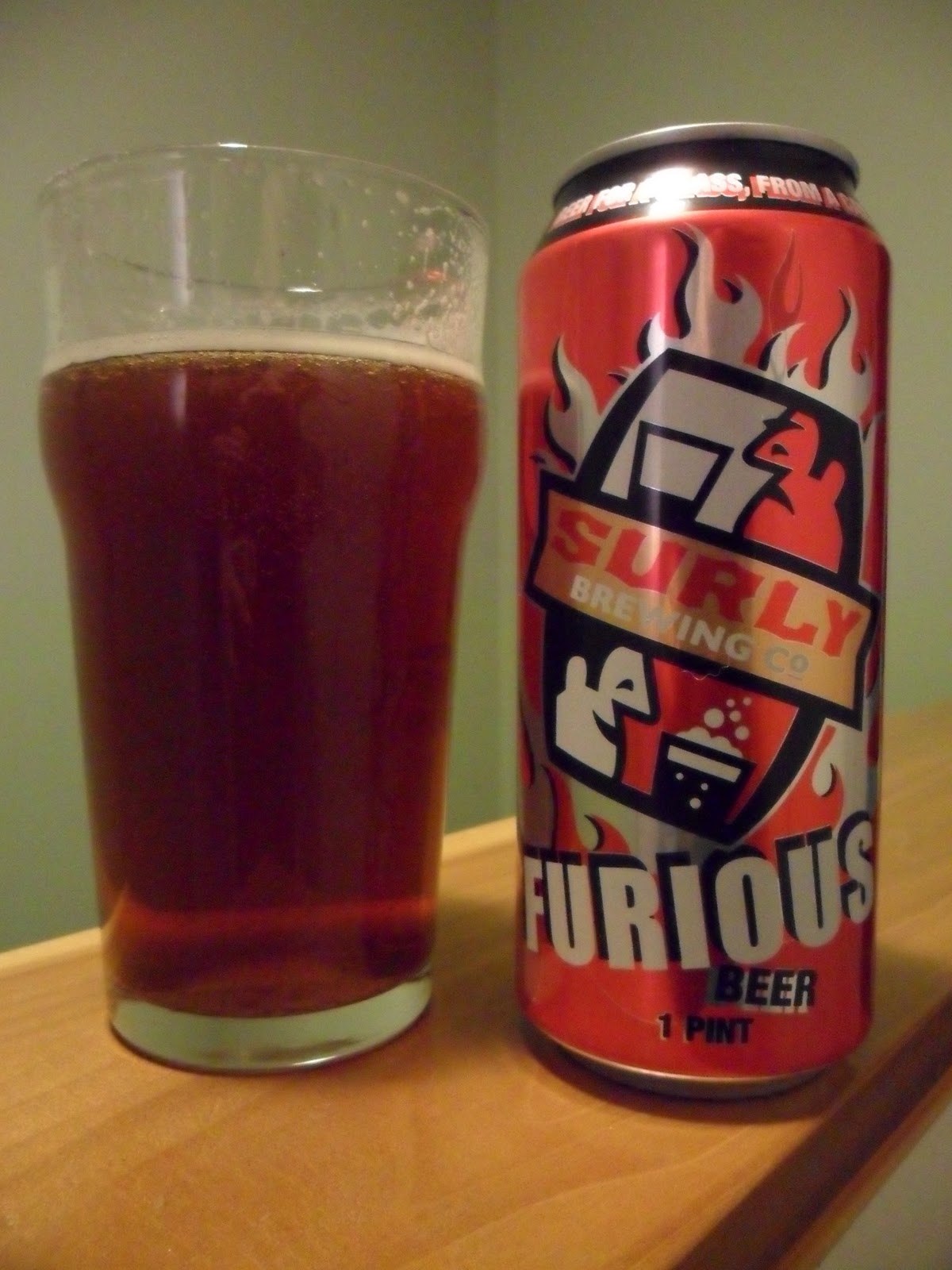
Beer: Surly Furious
Brewery: Surly Brewing Company (Brooklyn Center, Minnesota)
Type: American IPA
ABV: 6.2%

A microbrewery with an image I can get behind, Surly is one of the giants of the Minnesotan craft brewery industry.  Although they have an impressive array of brews - most of which are only available in canned form - Surly is perhaps most famous for their "Darkness" series of Russian Imperial Stouts.  Each season around Halloween, the new batch of the brew is released with a different label character (Dracula or the Grim Reaper, in past years), with the bottlecap sealed in different-coloured wax.  Surly is also well-known for their 'Abrasive' and 'Furious' IPAs, the latter of which I managed to get a hold of this past week.  Suffice to say, I am pretty pumped.

Poured into a nonic. A nice bright copper-amber brew that left a thick, creamy head.  Tons of lacing here, while the head survives as a thick ring. Some sediment flakes are suspended throughout the glass. Looks brilliant.

Nose is wonderful hoppy goodness. Grapefruit, earth, tropical fruit, resin, toffee, bread. Could have been a touch stronger, but man was this nice.

A great IPA that delivers a hoppy blast in a big way. Starts with a bitter citrus hoppy blast, mellows for a moment to let the malts and sweet fruits (mango, lychee) get some attention, before another bitter hoppy wave hits you on the way out. The finish is very long and hoppy. Terrific stuff.

Slightly creamy, thinner bodied, mild but potent carbonation. I could sip this all night.

Definitely did not disappoint. I haven't had a good American craft IPA in a while and this was a great brew to break that fast. Surprisingly balanced, fruity, yet of course the hops steal the show. Wish I could have more of this...one will not suffice!  Unfortunately, I might have to wait for some time before I can have another of these; near as I can tell, Surly's distribution is pretty well restricted to Minnesota and a few scattered specialty beer shops in nearby states.  Yet another reason for a road trip...   (Grade: A)

Beer: Southern Tier Imperial Gemini
Brewery: Southern Tier (Lakeport, NY)
Type: Double IPA
ABV: 10.5%

Another seasonal/one-off effort from a longtime LCBO mainstay, Southern Tier.  These are the folks that brought us Imperial Choklat and Imperial Pumking last year - two big beers that also boasted huge flavors.  Clearly, "imperial" is a theme that Southern Tier's brewers seem to enjoy working with, with fairly impressive results thus far I have to say.  Indeed, I've been quite happy thus far with Southern Tier's imperial series that have made it up to Ontario, although their flavors and alcohol content often necessitate one to share the bottle with a friend.  A bottle to oneself can be a bit much.

Gemini is actually a straight blending of two of Southern Tier's everyday brews - Hoppe Extra Pale Ale and Unearthly IPA - the twin beers are intended to remind the drinker of the harmony found within the constellation Gemini and the 1960s space program named after it.  The brew's recipe calls for a lovely array of "big C" American hops - Chinook, Cascade, Centennial and Columbia. 


Poured into a nonic. A pale amber hue with about an inch of fluffy head. A good deal of lacing is left behind, and the head survived quite nicely throughout the pint, especially with a top-up later on to finish off the bottle.  Looks right on the spot.

Nose is resiny and citrus hops, tropical fruits (pineapple, mango, lychee) and bready malts.  Smells divine.

It took me quite a few sips for me to really see where Southern Tier was going with this, but when I did I certainly can say I enjoyed it.  This was a boozy, fruity hopbomb to be sure, but I think the pale ale created stronger malty backing than the hops could handle. Indeed, this is quite malty and surprisingly sweet.  Far sweeter than the Surly Furious, at any rate. Finishes with a nice little citrus hop kick, however.

Big flavor and alcohol make this a slow sipper to be sure. Creamy, thin bodied.

Pretty interesting brew here. I think the hops got a bit overrun though, as the malts and tropical fruit flavors gave the brew a nearly cloying level of sweetness. Still, enjoyable nevertheless and worth a try. At nearly 10 bucks a bottle though, I doubt more than one bottle of this will make its way into my fridge this year.  (Grade: B+)

There are scads of other IPAs and Double/Imperial IPAs to be found in the States, as it seems that nearly every craft brewery worth its salt has at least one or two in its lineup.  It's a style that is certainly hit or miss with most folks; if you can't get over the initial bitterness, I wouldn't blame you for a second.  A good thing to keep in mind: once you take those initial few sips, your tastebuds will acclimatize to the hoppy goodness and you'll be able to detect more flavors - malt, caramel, fruit and the like - from then on.  If you give IPAs some time, you'll find yourself becoming more and more addicted to Vitamin Hop with every sip, like folks who put ever more and more hot sauce on the foods they eat.  Eventually, lower-hopped brews might not cut it for you; I often have to remind myself that not every beer need be a hop bomb.  It's a slippery slope, but damn I love it.

Other great ones to try, if you can find them (most are from California and the West Coast):

Russian River's Pliny the Elder
Bell's Hopslam
Lagunitas' Hop Stoopid; Lagunitas IPA 
Oskar Blues' Gubna Imperial
Ninkasi's Total Domination
Stone's IPA

Monday, March 21, 2011

Spring Drinkin' - Doppel Your Pleasure, Doppel Your Fun!

Ah, spring...

Finally, the winter chill seems to have left Ontario, leaving behind a grey, sludgy mess that will take a good month or so to clear out.  Homer Simpson was wise indeed when he coined the term "Smarch" to describe such drab late-winter weather.  Though there's still a bit of snow on the ground and a nip in the air, spring weather is just still around the corner.  Enough of the damn cliches - what this really means is that its time to roll over a new beer season on the calendar!

Though the stouts, spiced ales and barleywines of the winter will not be fully left behind in the coming months, I will nevertheless be moving my focus towards other styles more in tune to the new season.  For the more devoutly Christian among us (or merely those who feel like boastfully starting - and then immediately failing - a yearly period of asceticism), the change in the season heralds the beginning of the Lenten period, a time of fasting and repentance.  Since few people today are willing to truly fast during this period, most people instead choose to withhold from a particular something they enjoy for the forty day period.  Chocolate, fried food and the like.  Yet a few of the crazier folks out there go whole hog and do the unthinkable, and that's to give up booze for nearly six weeks.  Not only is this a terrible, awful choice, it's also not really appropriate for the season; if you don't believe me, consider the most devout individuals in Christian history - the monks.   As noted beer judge and author Randy Mosher observes, Christian monks throughout recent history have seen strong beers as being a sort of  "loophole" from the seemingly oppressive rules of the Lenten fast.  Learned fathers of the faith declared that "God somehow overlooked banning beer along with meat, and so took full advantage," bless them.  Since beer has been such a nutritious beverage throughout its history, monks were sustain themselves throughout the periods in which solid foods were forbidden by indulging themselves on strong lagers - the bock being the most popular of these in the German states - without violating the spirit of their vows.   Now I'm certainly not attempting to take away from the impressive display of piety displayed throughout Lent by the disciplined members of the various monastic orders; I'm merely trying to point out that giving up beer for Lent isn't something even monks are willing to do.  So, if you want to celebrate and honour Lent, pick something other than beer to give up.  Seriously. Please.

As I've mentioned before, bocks are strong lagers that are usually quite rich, malty, fruity and with only a mild hop character to them, if there is any at all.  Because lagers require cooler temperatures for the yeast to ferment properly, these beers were best brewed in the cold, winter months and would thus be ready just in time for the onset of spring and the Lenten season.  A popular variation of the bock style is the doppelbock, which originated from monks of the Paulaner order of southern Germany (the same folks who gave the name to Paulaner Weissbier).   Doppelbocks are, as you might expect, stronger and sweeter than your standard bock, but they still display the same malty, hearty flavors associated with the bock style.  The LCBO, as part of its spring beer release, has put forward a few lovely examples of doppelbock to herald the springtime.  Here are a couple of my favorites.  Both are terrific and are reasonably priced, at around 3-4 bucks for a tall bottle. 

Beer: Amsterdam Spring Bock
Brewery: Amsterdam Brewing (Toronto)
Type: Doppelbock
ABV: 7.4%

Amsterdam is a brewery that has yet to really impress me much.  While they might have the moves, they don't have the touch.  Now don't get me wrong, I certainly think they're alright.  But that won't satisfy the already snooty preferences of a John Q. Craftbeerman such as myself.  The standard slate of offerings that one might find in the LCBO or on draught in downtown Toronto are certainly fine, and I feel much better drinking something locally-made than the corporate junk that I usually find on-tap, but then again the brews aren't really impressive either.  While I've been very glad to see Amsterdam brews on tap at many a GTA establishment, what I've seen has been very run-of-the-mill stuff - a blonde, a nutbrown, a red, etc.  To be fair, this isn't a problem that's unique to Amsterdam, or even for Ontario craft breweries as a whole.  Indeed, there are scores of craft breweries that only seem to produce passable, unimpressive stuff, solely because it sells and keeps the business going.  I certainly realize the need to appeal to broader demographic of drinkers, and thus I will still support them nevertheless.  But it would be nice for a brewery to stand out not just by virtue of it being "craft" or "local", but rather because it brews exciting, terrific beer on a regular basis.  Thus my trepidation at seeing Amsterdam Spring Bock among the LCBO's spring releases. 

With this in mind, imagine my surprise when I see that Amsterdam has produced a terrific bock-style beer that is head-and-shoulders above the rest of their lineup - hell, it's better (and more ambitious) than a great many brews in the province I've encountered thus far!   This was a terrific little brew (now I shouldn't say "little" here, because it packs a punch at 7.4% ABV!) that truly followed the traditional German bock style.  Let's have a look!

Poured into a conical pint glass. A deep, chestnut amber brew, with the pour leaving a thick off-white inch of head. Decent retention, survived as a thin ring. Some lacing.

The nose is exactly what I look for in a bock - rich malt, raisins, pumpernickel bread, dark fruit, caramel and toffee. Off to a good start!

Amsterdam Spring Bock tastes as good as it smells, and is a stand-up bock all around.  Boozy, rich, big pumpernickel flavor, caramel and all the usual suspects. Finishes dry and slightly bitter.  The beer boasts a thicker mouthfeel, which is slightly creamy with mild carbonation.

This brew was a real surprise.  A great tasting bock, perfect for the beginning of the warm spring weather.  It drinks well, although one bottle at a time is certainly enough.  Easily my favorite Amsterdam brew I've had thus far. Would that they could brew their other fare this well!  I'll certainly be encouraging Amsterdam to keep brewing stuff like this by snapping up a few more bottles to keep me rolling through the spring! (Grade: B+)


Now from something from the old country itself...

Beer: Der HirschBrau - Doppel-Hirsch
Brewery: HirschBrau (Sonthofen, Germany)
Type: Doppelbock
ABV: 7.2%

This Christmas I received a gift pack from Der HirschBrau, a lovely little brewery about as far south in Germany as one can get.  Their doppelbock was my first brew from Hirsch, however; last spring I seem to recall drinking several bottles of it.  Time to rekindle that tradition.   

A lovely swingtop 750mL bottle.  Since the symbol of the bock beer is a stag, it's only appropriate that this doppelbock brew feature two stags locked in mating-season combat. 

Poured into a classic German-style beer mug I had kicking around.  A rich, dark ruby-chestnut - lovely when held to the light. Despite an aggressive pour, only about a half inch of head that quickly dissolved into a ring. A few flecks of lacing.

The nose opens in a big way with a huge whiff of caramel and toffee, followed by a touch of dark fruit and spices.  Pumpernickel bread and booze round things off.

Sweet caramel and chestnuts up front, then a fruity, spicy finish.  A bit of warming alcohol creeps in here, but the taste of it isn't unpleasant.  Rich, yet easy to drink.  Definitely a sipper - hearty and delicious. Thick carbonation, with a medium-thick body. Slighty creamy, chewy.

A great doppelbock, definitely one to keep in mind for cold winter/spring evenings.  It's a slow drinker to be sure, not something you want to power through due to the high ABV and hearty nature of the brew.  Indeed, after a single bottle of this, I was certainly half in the bag.  It's cellarable, so I might have to pick up a bottle or two for storage since the LCBO seems to be making a habit of releasing this beer each spring.

It may not seem like spring just yet, but there's still reasons to celebrate, and a rich hearty lager is a perfect way to usher in the new season.  Both brews are well worth picking up, and are each excellent examples of the bock style if its unfamiliar to you.   Drink heartily!

Monday, March 14, 2011

"For he goes birling down and down the white water..."

"A log driver's waltz pleases girls completely..."
Beer: Unibroue Raftman
Brewery: Unibroue (Chambly, Quebec)
Type: Belgian Pale Ale
ABV: 5.5%

 Another quick Unibroue review that didn't quite fit in with my Chambly theme from the last post.  Raftman is this Quebec brewer's salute to the men who worked as lumberjacks and log drivers in the throughout the province's history.  After chopping down huge timbers from upriver, log drivers would guide them through rapids and narrows along the route to the saw- or pulp-mills further downstream.  This was best done by balancing upon the logs themselves - literally walking on water - to breakup troublesome logjams using huge poles or rods.  An exceedingly dangerous occupation that somehow warranted a cheesy 1979 National Film Board of Canada animated short that featured an annoyingly catchy version of Wade Hemsworth's "Log Driver's Waltz."  If you live in Canada and watched the CBC at some point (i.e., everyone), you've seen this amusingly irritating film.  Naturally, the "Log Driver's Waltz" was the first thing I thought of when looking at the Raftman label, and thus that damned song has been in my head for the entire weekend.  Because I don't want to suffer alone, here's the link to that animated short.  I fully expect all of you to be humming this song by the end of the day...

On to the beer itself.  The Unibroue website states that this beer was brewed using whisky malt and should thus have a smoked whisky character to it.  We shall see!

Poured into a Chimay goblet.  Pale amber-copper, slightly opaque with that yeasty sediment.  About an inch of fluffy head quickly recedes into a thin, but sturdy ring. Lacing when the glass is tilted.

The nose is that distinctive Unibroue yeast, peach, apple, vanilla, and something I guess you could call smoke, but really it's probably my nose playing off the beer description because whatever it is, it isn't very strong.  Still, a nice smell to the brew.

Tastes like the typically good Unibroue fare, although I was a bit underwhelmed.  Nothing really stood out for me in this brew - the smoky, whisky flavors I was anticipating just weren't there, and if they were, they were so well hidden I can't really say I'm being honest about them.  Still, a not-so-fantastic Unibroue is still fantastic.  Easy to sip on a cold, dreary late winter's afternoon.

Slight sediment to the mouth, crisp carbonation, medium-bodied.

While this log driver's waltz won't please this beer blogger completely, it still was a decent beer.  Seriously, I'm not knocking it - a fridge full of them would be damned fine by me.  Because of the low ABV, this would make for a great session brew - something you could drink lots of without going off the deep end.  It also of the beer style I most like to drink so it's hard to knock it, but when I see Unibroue's website describe Raftman as a "a peat smoked whisky malt ale," I was expecting a great deal more than what was there.  (Grade: B+)