Tuesday, August 14, 2012

Vertical Beer Tasting (sort of) - North Coast Old Stock Ale, 2011 and 2012 Vintages

The lineup at a recent tasting of ours.  Informal setting,
"bring what you want" and with an added component:
an awful beer tasteoff between some of the big brands:
Bud, Blue, Stella, Canadian and Rolling Rock.  
Attending a beer tasting can be one of the most rewarding experiences in all of beerdom.  A gathering of friends, acquaintances or similar-minded fellow brew travelers to celebrate the diversity and quality of the brewing industry is one of life's great pleasures, and is something I look forward to whenever the opportunity arises.   Beer, after all, is a social beverage - it is best enjoyed in good company (that, and some of the brews out there are so bold-flavored or boozy that sharing becomes not just enjoyable, but a necessity!).   When you find a great brew, you want to share it with the world - or, failing that, good company from those around you.  This blog is really just a one-sided beer tasting; I would much rather be sharing these brews with all of you!  Truly, a gathering of different styles of brews, to be shared by people with different opinions and tastebuds, is very much an enlightening event.


There are many different ways to hold a beer tasting; by changing the expectations of the event, the experience can be tailored to suit your personal tastes.  Above all things, a tasting should be fun, friendly, and open.  The intent is not to pronounce formal officious judgement upon the beers of the world, but rather to crack open some brews and see how we feel about them.  Keep it low key, but interesting and with respect for what the brewers have put forward for you to enjoy.  People are going to have different opinions of every brew, and will experience them differently based upon their personal tastes and their prior experiences with beer.  Thus, when hosting one of these shin-digs, be open to other people's perspectives.  If there's one rule I can impart to you about beer, it is simply this: Beer is one of life's great pleasures; Respect the brew, Respect those who made it, and Respect those who like it.

North Coast Old Stock Ale, the subject of today's tasting. 
As a specific recommendation, I suggest accompanying foods that compliment the brews, with chocolate, cheese, bread, fruit and meats being the standards.  Not only will this help stave off the inevitable drunkenness (after all, at a tasting, it is nice to remember the beer that you've sampled), but pairing these foods with the brews can bring out some of the better flavours of each.  Recently I was privileged to try a bottle of Uinta Labyrinth Stout, a heavy hitting brew made with anise.  The host provided some dark chocolate that also contained anise; taking a bite of chocolate and washing it down with the stout provided me with an opportunity to detect unique qualities in the brew I might otherwise have missed.

So, if you are hosting, be sure to have a good slate of brews and snacks available from your own cellar (outsource to your guests if possible), and graciously accept the brews that others have contributed, regardless of what they might be.  Had it before?  Others might not have.  Had it before and hate it?  Others might love it.  Don't be a dick about this - again, "Beer is fun."  Discussing our thoughts about each brew can be really entertaining, especially if fisticuffs are involved.   If you are hosting or attending a tasting, I highly recommend bringing larger bottles (750mL), to allow as many of your guests as possible to have a large enough sample to enjoy.  Finally, and this is absolutely essential, under no circumstances do you spit out the beer.  PERIOD.  

There are a few different ideas for how to hold your tasting, and I'll go over them quickly.  As a general rule, the more informal, the more people can probably attend comfortably:

1) The informal, "bring what you want" tasting, which is the most popular, for obvious reasons. No real rules, other than that everyone should contribute something, either a brew they've been meaning to try, an old favorite, a "flavor of the month" brew, or a real rare edition.  Again, respect the sampling you have to work with: some people will bring crazy rare aged expensive brews, others just what they can find (in Ontario, this can be a real challenge). I've been to some where there was just a massive table full of open beers (about 30 attendees) where it was a sampling free-for-all with no one necessarily drinking the same brew at the same time as anyone else, and others where only a small group contributed some random brews of their choice, and we decided the tasting order as a group and drank as a group.  Both were fun events, so it depends on what you are looking for!  One of the benefits of this setup is that it can be really exciting to see what other people think to bring to the table, and it allows you to taste brews you might otherwise not have actively sought out.  It also can really broaden your horizons when it comes to what is available.  Another advantage of this arrangement is that it allows people of different interests in beer to participate without placing too much demand upon your guests.   As host, something to keep in mind is the order.  Obviously, check with your guests to see if there's anything they want cracked open right away while all of our constitutions are still with us.  As the evening progresses, change your style accordingly, but stick with a general consensus.

2) What I call an "Elevating" tasting, where you start with a particular alcohol content or style of beer, and work your way up from the lowest alcohol or the least strong-flavored beer to the strongest.  Really, just a way of arranging the tasting.  To organize this, each guest should bring a style and sign up.  I just find it easier to arrange whatever people bring into a logical progression, which admittedly ends up being similar to this.  

3) The "Horizontal" tasting.  A bit more formal, but not too difficult to arrange if you give folks some time.  A horizontal tasting means that all the beers at the event should follow along a particular theme, whether it be a region (brews of Ontario, brews from Bavaria), a particular style, a specific brewer(y), ingredient, or perhaps a seasonal theme (i.e., Hallowe'en brews, Christmas ales, etc.).  For something a bit more formal, try to keep all of these brews from around the same year. For example, if the night's theme is the Belgian Tripel, it can be fun to compare different brews from various regions from the same year, to see how they differ.

4) The "Vertical" tasting.  Far more specific, and probably something that you will have to arrange yourself, and/or with the help of a great local beer store or some collector friends.  While a horizontal takes a specific theme, but maintains the year, a vertical takes the same beer, but examines it over different years (or for the wine folks out there, vintages).   The goal here is to see how a particular brew changes or ages over time.  In one of my beer bibles Tasting Beer by Randy Mosher, he takes us through a vertical tasting of one of the legendary barleywines, J.W. Lees Harvest Ale, which involves every edition of that beer for a dozen years or so.  Another popular vertical, for those who enjoy this brew, is Three Floyd's "Dark Lord" imperial stout, which lends itself to the collector by virtue of its wax cap that is coloured based upon the specific year (this year's is red, last year was yellow).  Obviously something that takes a great deal of effort and patience to acquire, although some of the better beer stores in the states will often carry a few vintages of the same brew for you to purchase.

Today, we'll try a mini vertical of a brew that is quite popular for vertical tastings: North Coast's Old Stock Ale!

North Coast is one of California's premier craft brewers (for a state that craft beer rich, that's saying something), with its big brews being the Old Stock and Old Rasputin Russian Imperial Stout - the latter being a brew that is particularly dear to my heart.  The Old Stock Ale is of a style known as - surprise surprise - "Old Ale", meaning a strong dextrin-rich ale that has been aged in order to mature it.  I recently acquired the 2011 and 2012 editions of this brew (coincidentally in order to help a fellow beer lover complete a six year vertical for the years 2007-2012), and so I thought I'd do a little tasting of my own to see how the two compare!


We'll start with the 2012, just so we have a benchmark of where the brew starts, and from where it could potentially go.

Beer: North Coast Old Stock Ale
Brewery: North Coast Brewing Co. (Fort Bragg, CA)
Type: Old Ale
ABV: 11.9%

Poured both of these into wine glasses (shared it with my wife), with a little bit set aside of each for direct comparison.

2012:
Dark caramel-chestnut in colour, clear and with a fine wisp of white head that survives for only a few moments.  Not the world's greatest looking brew, but about right for the style.  Something about barleywines or high octane ales chemically that seems to reduce their ability to produce a head.

Nose is quite pleasant, with strong notes of caramel-toffee malt, red grapes, a touch of smoke and leather, booze, grain and wood.  Alcohol is certainly present on the nose (after all, we're looking at almost 12 percent here), but still quite pleasant.

A tasty brew indeed, with similar tasting notes as in the nose.  Big malt blast, with subtle notes of grape, smoke, wood and grain.  Not overly sweet, and with a long boozy finish.

Mouthfeel has some zippy carbonation that gives the brew a strong bite, and there is a lingering alcohol burn with every sip.  I would use the word "hot" to describe this brew - it could use a bit of aging.  If only we had a brew like this that had aged for, say, a year?

2011

Hey, this could work!  Let's see what a year of aging does for this brew.  Like Huey Lewis and the News, we "gotta be back in time!"

Similar colour as the 2012, maybe a bit lighter.  First difference between the two: the '11 had absolutely no head to speak off, instead sitting stubbornly in its glass with nary a hint of life.  A year in the bottle has certainly reduced the brew's ability to create that bubbly cap.

Nose is quite potent, with that same malt blast with hints of smoke.  The difference?  A stronger red wine blast - almost port like - than the '12, and with considerably more sweetness to the nose.

The taste exhibits similar qualities.  The malt is that much sweeter, the palate that much smoother, the accompanying notes that much more pronounced.  Add to all this a mouthfeel that is far less crisp and carbonated than its younger brother.  Slick and easy to drink.  Age has clearly mellowed out the temper of this brew, and produced a patient, wise Old Ale worthy of respect.

Even from this mini vertical, we can see how one brew can display remarkable change after even a single year of careful aging.  A vertical tasting that involves even more examples of that brew from different years would certainly provide a fascinating glimpse into the aging process.  Now, this sort of vertical works best with certain styles - a pilsner, for example, is unlikely to display much change over the years (if it does, it will probably be because it has gone foul), and those styles tend to be somewhat expensive.  These bottles, in Buffalo, were about four dollars each.  So, to conduct a vertical tasting, you will certainly require the funds, the initiative and the patience to get a good list.  But if you get a chance, I highly recommend it!

Next up, we try a horizontal tasting with a specific style - Belgian raspberry lambic!  Stick around!


Friday, August 3, 2012

Granville Island Brewing - You Never Forget Your First


Olympic time is here again, which means that my TV has been stubbornly locked on one of the five major broadcasting channels for the past five days.  Those who know me are quite familiar with my love of all things Olympics, and are probably sick of me spouting random Olympic facts and citing the medal tallies from Innsbruck 1976 (Did you know?: Denver originally won the rights to host the 1976 Winter Games, but due to crippling costs the State held a referendum that vetoed the games, so the IOC granted them to Innsbruck?  See - I'm at it again....).   As a child, I was obsessed with maps, flags and knowing national capitals, so something like the Olympics is undoubtedly going to appeal.  Oddly enough, I think I'm more of a fan of the idea and set-up of the Olympics than I am of the sports themselves, which is probably a result of the Canadian team never doing that well, at least in the Summer Games - it's just not our bag.   Thus this week I've been thinking back to those glorious days in 2010, when the world came to Canada to watch us win all the gold medals.  It also got me thinking about the city of Vancouver, which is truly one of the world's most beautiful urban areas.   The fact that I'm not currently in Vancouver is of great distress to me: fortunately, some brews from that lovely city have made their way out east for me to enjoy!

Granville Island Brewing opened its doors in 1984, fulfilling the dream of brewmaster Mitch Taylor to bring English-style ales to pale-lager inundated city.  People (like me) tend to bitch a great deal about the availability of quality brews on tap in Canadian alehouses, but I have to admit we are light-years ahead of the situation that existed in the early 1980s, which was Labatt or Molson - take your pick.  For many, this was sufficient, but for whose tastes in beer went beyond what Frank Appleton termed "corporate beer" (there were many thirsty British ex-pats in Vancouver), they wanted something more.  By opening its doors as a brewpub, Granville Island became Canada's first microbrewery, and paved the way for other breweries across Canada.    Located in the heart of Granville Island, a lovely tourist island just south of Stanley Park that is filled with trendy shops, markets, buskers and artists, the brewery is a great place to visit for the brew-thirsty traveler.  I visited the Island and brewery about five years ago, which now that I think of it, was probably my first experience with craft brewing.  It's not that I was drinking horrible stuff before - at the time, I was particularly fond of Guinness, Smithwicks and Steamwhistle - but I hadn't really branched out beyond that.
Five years of beer drinking can do a lot to a man. 
My girlfriend (now wife) and I wandered into the brewery and were blown away by the variety of brews available.  English Pale Ale?  India Pale Ale? Maple Ale?  Hefe-something Germanic?  Like a good craft brewery should always do, Granville offered a sampler flight of their wares to give the curious as varied a tasting as possible.   I don't really remember what I drank that day - the important thing for me was that it was different.  The pale ale had something called "hops", a tangy bitterness that I wasn't really familiar sure if I liked, but was sure that I hadn't drank anything like it before.   The maple ale was utterly unlike any ale I had encountered.  The other two were probably pilsners or lagers, but each had something I was not used to: flavour.


It was an eye-opening experience to say the least, which helped begin my journey into the wonderful and fascinating world of craft beer.  A few months later, we moved to the Waterloo region, which boasted an impressive array of craft breweries to allow me to continue to whet my whistle.  Really, Granville Island was the brewery that got me started down this journey, and I certainly want to thank them for it.

Five years since I had my last Granville brew, and what should appear but a sample mixed pack featuring three of the Granville lineup, along side the three stalwart brews from Creemore.  Both Creemore and Granville have since been purchased by Molson, and how this has impacted their brewing is unclear.  It seems that Creemore has more or less been left alone to its own devices, with more distribution (how many bars in Ontario don't have Creemore?) and a few extra varieties.  I'm not sure what Granville's change has been, but the fact that their brews are now available in Ontario - their English Bay Pale Ale has been on tap and in liquor stores for a few months now - certainly shows one positive side of acquisition.


How will these brews taste five years later?   Let's have a look!

Beer: Robson St. Hefeweizen
Type: Hefeweizen
ABV: 5%

Poured this one into a small nonic glass.  Looks like your classic hefeweizen, sporting a hefty crown of foam under a hazy golden-tawny body.  Dark for a hefeweizen. Good retention, a bit of lacing.  Nothing wrong with that!

Nose is a bit more yeasty than I tend to like, but the usual hefe suspects are there: citrus (lemon), strong wheat malt, bread, floral hops.  Maybe a touch of banana and clove.  The yeast is a bit strong.

Certainly not a bad wheat beer by any stretch, as all the important elements are present.  Because of what I got out of the nose, I was expecting a yeastier brew, and that's what I taste as well.  I'm not a fan of this flavour, but the brew still tastes fine.  A bit of citrus, banana and bubblegum in the mix.  It doesn't stick the landing, but it gets a decent score!  Smooth, lightly carbonated.

I imagine that this brew would taste a lot better sitting on the patio overlooking Granville Island.  Then again, what wouldn't?  Still, a decent wheat beer indeed.

Beer: Brockton IPA
Style: American IPA
ABV: 6%

Nothing beats an American-style IPA, and lo-and-behold, today (August 2nd) is IPA Day around the globe, and certainly around the USA.  After years of bouncing between the various styles of brewing, I have to say that a well-hopped pale ale or IPA is probably the style I love the most on an everyday basis.   This brew claims to be "generously hopped", which should be a real treat.

Poured into a nonic.  Lighter amber in colour, with a thin white head that dissolves into a fine ring after a few moments.

Strangely sweet smelling.  I'm really not getting much in the way of hops here, just a mild bitterness and a touch of citrus.  Quite malt heavy indeed.

This sweetness translates into the taste, and I have to say, it's not doing it for me.  It tastes fine, I'll grant you, but it's a far cry indeed from its American IPA brethren.  Stack this brew against, say, Red Racer IPA from Surrey, Mad Tom from Muskoka and you'll see what I mean.  Tastes far more like an English Bitter or even an English Pale.  Thinner bodied, mild carbonation.

A miss for me.  Though the brew held great promise, it didn't stick the landing.  Maybe this brew has been affected by the journey east (unless it was brewed by an Ontario brewer, then there is no real excuse), because it just doesn't feel like an IPA.

Beer: English Bay Pale Ale
Type: American Pale Ale, but probably closer to an English Pale.
ABV: 5%

One of Granville's flagship brews, English Bay was the first to make the journey out to Ontario both on draught and in six-packs.  I had this on draught a little while ago, and thought it was fine, so I was looking forward to taking a closer look.

Poured into a nonic.  Deep amber copper, clear, with a sturdy head that produced some strong lacing.  Decent looking brew indeed.

Nose is pale malt, a touch of bitterness, some chemical business I'm not really digging.  Nothing fantastic here.

After a wobbly start, this brew pulled together a decent routine.  A relatively safe pale ale, malt heavy, with only the mildest presence of hops.  Mild chemical flavour, with tea-like hops, both of which strongly suggest that this brew is of the English style.  Certainly drinkable, and sessionable given the lower ABV, but nothing to get too worked up over.

Well, there's an old expression from Thomas Wolfe that comes to mind after drinking these brews: "You can't go home again."   Though it initially meant the inability for one to return (in spirit) to their hometown after leaving home and seeing the world, it has entered the lexicon to represent that feeling of not being able to repeat great memories once you've experienced them.   I loved Granville Island's brews when I first had them, on a glorious summer day in the heart of Vancouver.  Sitting on my patio is great and all, but it's just not the same, and the beer may have experienced a decline in quality due to increased brewing demands and the effects of shipping/brewing the recipe elsewhare.  That, and in the five years since, my tastes have changed immensely, which has meant time and time again that I often have different perspectives now on the brews I loved then.   So maybe this isn't totally fair to Granville Island.  These brews were just fine; they just weren't anything to get excited about.   Beer is most assuredly an experiential brew, that is improved immensely when the situation is just right.  An average hefeweizen probably tastes like Ambrosia on a crisp spring day in an German biergarten, an IPA at the campsite in the Pacific Northwest would be like nothing else.  In Granville's case, sitting on the brewery's patio, looking over the harbour and across to Stanley Park is going to heighten one's perceptions of things.  Rest assured, however, that should circumstances favour me, I would love to give these brews another shot on their own terms and in their home court.

Cheers to Canada's first craft brewery!


Monday, July 2, 2012

LCBO Summer Release

The summer is here at last!

I am now done with school for the summer, and the local kids are out raising all kinds of hell around the neighborhood.  The dominance of the Spanish national football team continues unabated, and the woeful display of the English team in the quarterfinal amused us all.  The garden is progressing nicely, and the air conditioning in my room continues to function as promised.  The weather has been so hot and sunny recently, I decided to celebrate with some new brews, and fortunately my timing was excellent, as the LCBO has recently shipped out the first round of their Summer Release lineup (the full list of the lineup can be found here).  Not a bad looking release, but I have to say I think the number of weizen beers is awfully high, and it seems as though ginger is the flavour of the season - if you don't happen to be fond of either, you're pretty shit outta luck.  Fortunately for me, I happen to be fond of both, so I'll do alright.  A few repeats from other seasons - including, yet again, Great Lakes Orange Peel Ale for some reason - but there are some interesting brews to be had, and we at the Den are privileged to give you an overview!

L-R: Weihenstephaner Kristallweissbier, Phillips Ginger Beer
Schneider Nelson Sauvin Weizenbock, Thornbridge Kipling Pale Ale,
and Birrificio del Ducato's New Morning Farmhouse Ale.
Normally, it would make sense to start things off with the wheat ales, both of which come from the great brewing and footballing nation of Germany.   However, there's a reason that I'm going to switch the order, and I'll get to that in a minute.  I will give Germany the right to first review, considering that this brew comes from the "oldest brewery in the world", Weihenstephaner of Bavaria.  Weihenstephaner brews are regularly available at the LCBO, and this is a very good thing, as their hefeweissbier and dunkelweizen are both fantastic brews and great to have on hand if you've got the hankering for a superbly crafted wheat ale.  If you're lucky, as I was, you might find yourself in view of a wonderful boxed set of Weihenstephaner brews along with a branded hefeweizen glass.  I strongly suggest you do so.


The brew that is part of the summer release is called a kristalweizen, which as you might be able to deduce from the name is a wheat beer that is kristal clear, unlike its unfiltered and thus hazy brother the hefeweizen.   Kristalweizens are designed as they are to reduce the yeast character of the brew for folks who would prefer it removed, as well as for simple aesthetics.  Since the development of the pilsner lager in 1842 and the development of inexpensive, mass produced clear glassware that occurred in the mid 19th-century, people have become more and more accustomed to seeing clear, unfiltered golden brews, rather than the murky ale concoctions that once graced the earthenware mugs and steins of old.  It's been an uphill battle for craft and traditional brewers of unfiltered beer to explain to contemporary customers that the beer is supposed to be hazy and murky, rather than it being a sign that something is wrong.  I actually had a customer at my former bar of employment attempt to return a pint of Mill Street Belgian Wit because she claimed it was murky and smelled like yeast.  I tried explaining that the brew was designed that way, but realized it was a losing battle and quickly gave her a pilsner.  Sometimes it just isn't worth it.


Beer: Weihenstephaner Kristallweissbier
Type: Kristalweizen
ABV: 5.4%

Bright golden in colour, clear as kristal, and with a fluffy billowing head that somewhat quickly dissolved into a fine ring.  Some lacing, a bit more is produced when the glass is agitated somewhat.  Clearly, those big billowing weizenbier heads are not going to be the defining characteristic of this particular kristalweizen.

The nose is more in line with what we are used to: banana, clove, wheat malt, herbal and spicy hops, but of course very little of that yeast flavor one often sees in other wheat beers.   Very pleasant.

Taste is quite similar to the nose.  Weihenstephaner's hefeweizen is among the top of its class, and the kristal is very much a milder, easier drinking (if that were possible) version of that classic brew.  An enjoyable brew: light and refreshing, softer and crisper than its cloudy cousin.  Banana and clove are present here, hops  are more herbal than bittering.  Soft feel, mild carbonation, thinner bodied than the hefe.  Ludicrously easy to drink.

I still prefer the classic hefeweizen, but this is still one enjoyable brew.  I've never understood the reason behind kristallweizens, but after drinking this one I can certainly understand the appeal.  I'll certainly be back for more of these as the summer moves along.  (Grade: A-)

Now we move things along to Italy of all places.   I was shocked to see this brew in the LCBO's list, considering how Italy, despite being a nation with a rich gastronomic and viticultural heritage, is really not a nation known for its brewing.  Other than Dolomiti and Moretti, I can't really think of too many Italian brews out there.  This is hardly surprising, if one only considers the history and geography of Italy.  The Greeks and the Romans, taking their cue from their Mesopotamian predecessors, viewed wine as being the drink of civilization and culture; beer, on the other hand was a drink for the "barbarians" (and, to some extent, the lower classes).   Plus, they had the excellent soil and climate to produce the wine themselves, with the main wine producing regions being in Italy, southern France, southwest Germany and Spain.  Thus the history of brewing has generally been the domain of Northern European nations - the Low Countries, northern Germany, the British Isles and Scandinavia - who could not grow wine grapes in enough quantity for the drink to be produced locally.  Beer was thus the family drink because it was cheap, easy to make and the ingredients were readily available (but don't get me wrong, I'm sure most Northern Europeans of the Middle Ages would have jumped on the wine bandwagon in a heartbeat if they could have done so!).   But the point remains - one can safely say that the history of beer will involve few mentions of Italy in its annals.

But in recent years there has been some exciting developments in the Italian craft brewing scene, with a few select brewers producing ales and stouts with real flavour and complexity. With brewing technology and equipment being so readily available, I'm not surprised that a few Italians wouldn't take up the craft.  And it looks like one of these brews made it overseas as part of this release.  This brew is called Nuova Mattinna, and has been helpfully translated on the bottle to "New Morning".  And it is a new dawn indeed for Italian brewing, and based on this brew alone, I think they are heading in the right direction!

Beer:  New Morning
Brewery: Birrificio Del Ducato (Roncole Verdi, Parma, Italy)
Type: Belgian Saison/Farmhouse Ale
ABV: 5.9%

This is a farmhouse/saison beer, a style that lends itself fairly well to summer drinking.  Light, funky, and usually with spice and light citrus hops and a bit of yeast as they tend to be unfiltered.

Poured into my trusty Duvel tulip.  A deep amber-orange brew, considerably darker than other saisons I've had recently.  A billowing head of foam is the result of the pour, and it lingers in the form of a substantial ring that some nice lacing patches.  The head looks very Belgian (if that makes any sense), as it sits in heaps and piles on top of the beer, giving the brew a wild, untamed character.  I've noticed this with Belgian yeast and I assume there's a scientific reason behind it.  Or I'm seeing things.

The nose is classic saison, but with a twist - a lemon twist, that is.  Soft wheat and barley malt, musk, a touch of yeast, clove, leafy hops.  Very pleasant.

Spicy and yeasty (although not overly so), with an assertive blast of lemon zest to open things off, while finishing with leafy hops and a touch of spice.  The carbonation is initially quite vigorous, but it tapers off - almost too much so.  Nice, refreshing brew, and certainly appropriate for the heat of the season.  It's quite exciting to find a brew from Italy that doesn't fit the pale lager mold, and it is also exciting to see that the brew was well worth the wait.  Hopefully this heralds a new morning for Italian craft brewing!  (Grade: B+)

Remember I promised that I'd get back to that other wheat beer?  Well, the reason for my delay is that two of the brews in this feature are unique because of one of their ingredients, and I wanted to explain a little bit.  As you probably already know, hops come in all different varieties, and thus the brewer has a choice as to which hops (and when, and how much) to use to to achieve different effects.  Some styles lend themselves to a particular family of hops. For example, State-side IPAs tend to use the bitter citrus hops of the Pacific Northwest, like Chinook, Centennial and Cascade, while English Pale Ales go with hops that give the brew a leafy, earthy tea-like quality - Fuggles and Goldings being two of the standards.  Some brewers enjoy experimenting with their hop usage by trying hops that normally are not associated with that style, in hopes of giving the brew a unique quality.  That is certainly the case with our next beer, Schneider's Mein Nelson Sauvin Weizenbock.  The odd name from what is normally a very traditional German brewery comes from the Nelson Sauvin hop, which hails from the lovely nation of Middle Earth New Zealand.  This hop is not normally associated with, well, anything because it is so new, being officially introduced in 2000.  It has big tropical fruit flavors like grapefruit, mango and tangerine, but its real appeal comes from its chemical similarity to the sauvignon wine grape, hence the name "sauvin."   It should be a great addition to a pale ale or hoppy lager, but a heavy wheat beer?  We shall see!

Beer: Mein Nelson Sauvin
Brewery: G. Schneider and Sohn (Kelheim, Germany)
Type: Weizenbock
ABV: 7.3%

Enjoyed this brew while watching the Germany-Netherlands match, which to no one's surprise was an absolute disaster for the Dutch.  Poured into my awesome Erdinger World Cup 2010 class with the football topper.  (I would have consumed it out of a Schneider Euro 2012 glass, but funny thing - doesn't exist!) Deep golden in colour, slightly murky, and with a big fluffy head that receded into a thin ring.  The yeast is nicely contained in the bottle, sticking firmly to the bottom, which hopefully will prevent the yeast from taking over the brew's taste.  Clearly, the kristallweizen is rubbing off on me.

The nose is quite pleasant, and I can certainly see the influence of the Sauvin hops immediately.  In addition to the traditional wheat notes of banana, bubblegum, subtle clove and other spices, there is also some white wine, orange, and tropical fruit as well.  Works pretty well, I have to say.

The traditional weizenbock flavors are all here, and there are certainly those subtle notes of tropical fruit and white wine, but unfortunately they aren't nearly as potent as I would have liked for a brew that really pushes the addition of these hops.  Perhaps a traditional hefe would have been better, or maybe a kristal, in order to showcase the new flavours, because the heft of the weizenbock tends to overpower.  The mouthfeel of the weizenbock is a bit much here, and the carbonation is milder than I would have liked.

An intriguing effort, and certainly enjoyable, though I really wonder if a different style of wheat beer would have been a better combination with the NZ hops.  It just felt too heavy, rather than light, tropical and refreshing as I had anticipated.  And, for the price tag (around nine bucks), I'll probably just get the one.  (Grade: B)

Well, this one didn't really give me the flavor blast I was looking for, but fortunately I have a back-up option that I feel will probably be better suited stylistically, and it comes from another of our great Euro footballing nations: England.  The English national football team reminds me a great deal of the Toronto Maple Leafs, and so I've always had a soft spot for them.  Immensely popular despite not having won anything since the late 1960s (1966 World Cup, 1967 Stanley Cup respectively), a huge and noisy fan base that includes a great deal of casual fans with little connection or knowledge of the sport, overhyped and overmarketed despite never really accomplishing anything, and both suffering frequent heartbreaking exits from major tournaments due to questionable calls, strange circumstances and their own stupidity.  That, and like the rule of ABE (Anyone But England), Toronto's list of haters is quite sizeable, meaning both teams generate a great deal of derision and ridicule.  Even though as an Irish fan and one who appreciates the precision and finesse of Germany and Spain, I quietly give my sympathies to the English whenever they play, because I know that feel...

But now on to the beer!

Beer: Thornbridge Kipling South Pacific Pale Ale
Brewery: Thornbridge (Derbyshire, England)
Type: English Pale Ale
ABV: 5.2%

Thornbridge is something I've been looking forward to for some time: a new English brewery that produces exciting, well-crafted beers.  Founded in 2005, Thornbridge has bucked English footballing tradition and has actually won a boatload of international awards for its craft ales, and has done so with an interesting connection to English history.  Their first brew I encountered, Jaipur IPA, is a nod to the British experience in India (random colonialism fact: the whole city of Jaipur was painted pink for some reason when the Prince of Wales visited in 1876), and was damned delicious.  This next brew is named in honour of the English poet Rudyard Kipling, author of Gunga Din, Kim, The Jungle Book, and the unfortunate paean of colonialism "The White Man's Burden."  For this reason, maybe Kipling is not the best choice of name for a brew.  Even if we take the controversial legacy of Kipling out of the picture, what does Kipling have to do with the British in New Zealand? (Cook or Darwin, perhaps?).  No matter, on to the brew, which also utilizes these Sauvin hops to give it that "South Pacific" feel.

Poured into a nonic.  Nice bright golden in colour, with a nice fluffy head that dissolves into a sticky ring.  Some flecks of lacing.


The nose is a delectable tropical fruit treat, with mango, grapefruit, tangerine, orange and white wine jumping out of the glass.  Some bittering hops and bread as well.

Ah, here we go!  Same tasting notes as in the nose, but with the potency that they deserve.  Loving the mango and grapefruit blast here - really digging these NZ hops!  Not to worry about the brew becoming overpowered with fresh fruit, as there is also a decent leafy bitterness keeping everything in balance.  Lighter bodied, moderate carbonation, slightly oily.

It was all I could do to drink this beer at the pace to grant it the consideration and contemplation it deserves, because it was so tasty it disappeared in just a few minutes.  Really impressive stuff, and a great showcase of the hops.  Though the name might not be the brew's best feature, it is certainly a brew worthy of repeat purchase.  Well done, Thornbridge! (Grade: A-)

As per the other brews on the release, here's a quick rundown.  I haven't had a chance to get to all of them yet, and it's doubtful I will, since they often don't get to every LCBO in equal numbers, and many of them are repeats from other years.

Phillips Ginger Beer - (Fruit/Spiced Ale, 5%) Phillips from British Colombia is one of my "gateway" beers into craft brewing.  I first had their IPA in 2007, and I was both mesmerized and confused by the overpowering hop bitterness in the beer, having never really had a true West Coast IPA before.  And I liked it.  Seeing them on the Ontario shelves was pretty damned cool, though the choice in beer wasn't necessarily a good one.  I've spoken many times of my trepidation with regards to flavoured beers, and am generally not a big fan, but the ginger and the Phillips name intrigued.  This one certainly packed a massive ginger punch, but it was so horrifically gingery that it gave me heartburn and was undrinkable for me.  Just too spicy for my tastes, but it might be one for you.

Shipyard Smashed Blueberry (Fruit/Spiced Ale. 9%) Shipyard is a Maine brewery that I've only encountered once before, in the form of a very dry Irish shout called "Blue Fin Stout".  Not my cuppa tea, but I'm always up for something new.  And this brew was really worth it, because in terms of flavored beers, this one was a real winner for me.  The stout base was thick, rich and loaded with chocolate, and the blueberries managed to compliment the brew nicely without overpowering or tasting artificial.  Potent stuff, might be worth simply sharing.

Punk IPA (American IPA, 6.2%) One of very few BrewDog products to make their way to Ontario, Punk IPA is back - in canned form this time (330mL).  Tropical fruit and West Coast hops are there, but the brew is drier and more peppery than I remember.  Still worth a go.

Happy Summer Drinking everyone!

Thursday, June 7, 2012

You got me drinking Bell's Bell's!

Second major brewery in our Florida tour is Bell's Brewing of the hilariously named Kalamazoo, Michigan.  In my beer-literature wanderings, the name of Bell's has cropped up many times, especially with regards to their Hopslam Double IPA, Oberon Wheat Ale, Two Hearted IPA and Expedition Stout.  These four giants have racked up some impressive accolades, and are among the most-reviewed brews on BA and Rate Beer; not to be outdone, their other brews in regular rotation have faired well for themselves as well.  Really, I would be satisfied to try any of the bunch myself, and I was in luck: Knightly Spirits had a solid selection of Bell's in six packs, and thanks to their generous "help yourself" policy, I was able to get together a decent showing of the lineup, including the Two Hearted and Expedition.  I also was the beneficiary of a priced-to-clear Bell's pint glass, which was in perfect timing, as being in a budget hotel did not provide me with a large array of glassware from which to sample brews.

Bell's is one of several craft breweries to crop up during the mid-80s rush of craft brewing, which affords them some claim to "veteran" status.  Under the guidance of founder Larry Bell, they released their first batches in 1985 and opened their Eccentric Cafe brewpub in June of 1993, making Bell's the "first Michigan brewery to sell beer by the glass to the public."  Cheers to Bell's for that, although it's very telling about the wasteland of the of American brewing industry up to this point that the first Michigan brewery to sell beer by the glass did so less than 20 years ago.  As of 2012, they are the nation's 13th largest brewery, and look to be undertaking a 52 million dollar expansion at some point this year.  It also looks like Larry Bell is contemplating selling the brewery, though not necessarily as a means of staving off any financial crisis, but rather as a means to ensure a succession of ownership.  Not sure what the future brings, but I wish all the folks at Bell's the very best in what could be a busy year!

For the bird-watchers out there, this is a Northern
Out-of-Focus Owl.  Very hard to spot.
I managed to snag a few bottles of Bell's brew, and with a couple of exceptions (their Pale Ale wasn't too impressive, and the Two Hearted was sadly past its prime and needed to be pitched), I was pretty damn happy with the bunch.  Here's a look at my two favorites:

Beer: Bell's Best Brown
Type: English Brown Ale
ABV: 5.8%

Chestnut-ruby in colour, slightly hazy, and with a few lingering flecks of sediment.  Left a thin, but sturdy head of foam, and sheets of lacing.  Nice looking brew.

Nose is classic English brown, with a few extra goodies: caramel, chocolate malt, English hops, raisins and a faint hint of toffee and roastiness.

This here's one sturdy, dependable English brown ale.  Simple enough to quaff heartily, yet busy enough to warrant careful consideration.  The caramel malt is pronounced, but not dominant, as the raisins and roasted character are allowed a foot in the door.  Medium-light bodied, carbonation is a bit higher than what you'd expect from an English version.

Damned decent brown ale, and well worth picking up if you get the chance.  (Grade: B+)


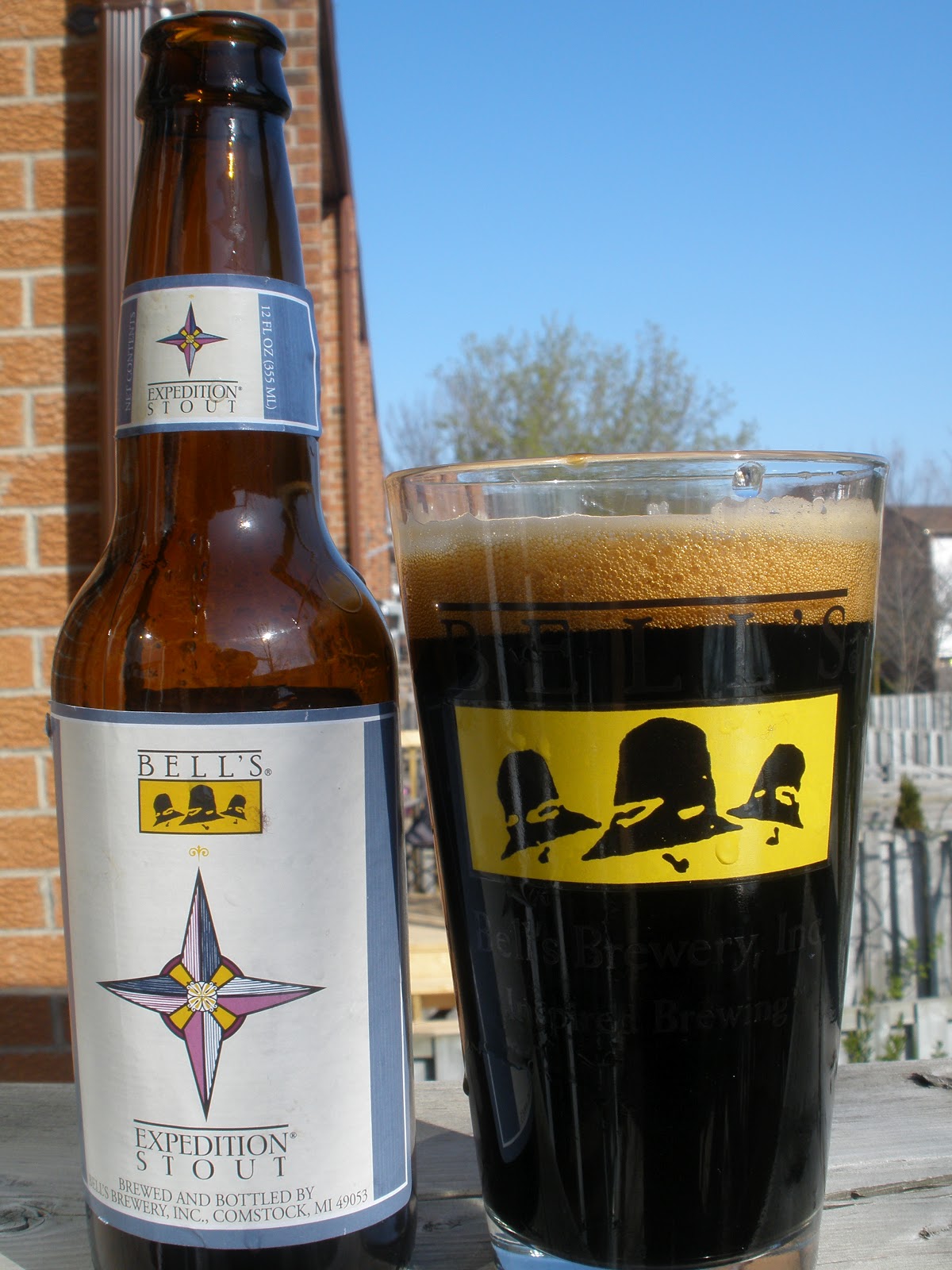
Beer:  Bell's Expedition Stout
Type: Russian Imperial Stout
ABV: 10.5%

This brew was so high on my anticipation meter that it ended up making the journey back to Canada so that I could afford it the proper attention it deserves.  Fortunately, it survived the flight unscathed, and we are ready to rock!

To paraphrase the classic scene from Rob Reiner's classic This is Spinal Tap: How much more black could this be?  The answer is none...none more black.  Textbook Russian stout: the pour yielded an inch of deep mocha foam that would not quit, and the lacing rings left behind rivalled the age lines of a mighty sequoia.   In brief, this brew looks terrific!

The nose is also pretty damned fine, though it is not this brew's most outstanding attribute.  Roasted grain, coffee, chocolate and cream are present, along with a faint whiff of dark fruit.  Not quite as potent as other great stouts I've encountered, but still classic Russian Stout all the way.

 This is one tasty stout, and I'm kicking myself for not bringing back more.  (Grade: A, maybe an A+ if I had a dozen more to really make sure.  The larger the sample pool, the better.)


With beer glass in hand, I am ready to keep my eyes open for more Bell's brews, especially considering the no-show and the brew that went past its prime.  I feel like I didn't get enough of a taste, but what I did get to try was terrific.  Give'm a go when you're out Michigan way.

Saturday, May 19, 2012

Smuttynose "Big Beer" Series

D'awww....
 Keeping things rolling with our Knightly Spirits haul is a dynamic duo from Smuttynose Brewing of Portsmouth, New Hampshire.  I've been interested in sampling some brews from these wonderful folks since I first really got into craft beer.  My first resource for all things brews was an Eyewitness Companion guide to beer, edited by the late "beer hunter" Michael Jackson, which provides an excellent overview of the many different beers to be had around the world.  It was here that I first became enamoured with the American craft beer scene - its scope, diversity, its potential for growth, and the subculture that surrounded it.  I also feel in love with the unique and spectacular artwork and bottle designs that many of these breweries incorporated into their lineup, especially those who employed the services of artists local to their communities, and whose brews reflected the local character and history of the region.  Smuttynose is a prime example of this trend, and was one of the breweries featured in Jackson's work that really appealed to me.   Possibly because their brewery logo is a seal, and seals are awesome.

Smuttynose Brewing was founded by Peter Egelson in 1994 in the city of Portland, New Hampshire, and has since become one of the giants of the New England craft brewing scene, quickly surpassing the maximum output to be considered a "microbrewery."  It now is able to ship its brews in various markets on the Eastern Seaboard, including - of course - Florida.  The brewery is named after nearby Smuttynose Island, one of the Isles of Shoals located a few miles off the coast of New Hampshire and Maine.  The island itself is home to pods of Common Harbor Seals, which are the inspiration for the company's logo.  The brewery has long called the city of Portland its home, but for most of the past decade it has been attempting to move its facilities elsewhere.  Credit of course to the brewmaster, whose brews have been so popular that the brewery's output has skyrocketed to over 300,000 cases a year, and the old brewhouse is simply too small.  After two unsuccessful attempts to move its operations, Smuttynose has finally chosen a location for its new home.  The location is just south of Portland in the town of Hampton, and the property is an old farmhouse.  The farmhouse itself was in a less than ideal location, and so as part of the brewery's plans for moving into the lot, the house needed to be moved.  You can see the process of moving the house here.   It looks like the brewery's new digs will be operational by the end of this year - I wish them the best of luck in getting some quality brewing underway!


The brews of the standard Smutty lineup include a Belgian Pale, an American IPA, a Brown Ale, and a Robust Porter.  Thus far, I have only had the pleasure of sampling the Old Brown Dog brown ale, and it was pretty scrumdiddlyumptious.  In my wanderings through the well-stocked aisles of Knightly Spirits, I was recommended by one of the staff to give some of Smutty's "Big Beer Series" a try.  This special series of brews, like Uinta's "Crooked Line", are seasonal offerings that explore some of the more complex styles of brewing.  Because of their popularity and limited release times, these beers are sometimes - according to the website - "maddeningly hard to find."   Not so at Knightly Spirits!   At the specific recommendation of the staff member, I went with their Imperial Stout, whose bottle design shows the island of Smuttynose in an olden style nautical map.  My wife, a huge barleywine fan, opted for the Barleywine Style Ale - no info about the label I'm afraid, but the peasant girl imagery is quite appealing.  Let's dive right in!

Beer: Smuttynose Imperial Stout
Type: Russian Imperial Stout
ABV: 9.8%

Poured into a small conic glass.  This brew, like most RIS's is inky black, with only the faintest hint of chestnut around the edges.  The head is a sturdy mocha cap, and it leaves a hefty amount of lacing around the glass.


When a Russian stout is done right, you can tell right from the first whiff.  Though I've often found that a great many examples of the style have a similar nose, because that combination of flavors is so appealing to me (coffee and chocolate is one of my favourite food-drink combinations), I rarely mind in the slightest that there can be a lack of diversity between brews.  Smutty's stout falls squarely in this camp - it's not a unique nose, but damn is in impressive.  Delectable dark chocolate, fresh coffee, cream, toasted bread, more chocolate, a bit of grape.  Just lovely.

Truly, this is one tasty stout.  The combination of chocolate and rich coffee does not disappoint, as this brew is both sweet and bitter, rich and smooth, and an absolute pleasure to drink.  A light grape flavor lingers in the back, which is augmented by a touch of smoke.  Finishes dry and roasty.  Superb stuff.   Silky mouthfeel, with only a slight booze character to the tongue.  Medium low carbonation, coats the tongue well.   Long dry finish.

Gotta hand it to the dude at Knightly for setting me up with this brew - very impressive.  Again, there's a lot to be said for doing something that's been done, but doing it extremely well, and Smutty has certainly delivered on that front.  (Grade: A)

Beer: Smuttynose Barleywine Style Ale
Type:  American Barleywine (i.e., uses American hops)
ABV: 10%

A brew shrouded in mystery.  In addition to not really understanding the bottle label, I'm not sure why this brew is called a Barleywine "Style Ale", as if barleywine was one of those Eurozone protected names like Cognac and Stilton.  It's listed on BA as being a barleywine, and it really tastes like one.  Walks like a duck, talks like a duck, I guess.  But rest assured, unless there's a technical reason for the naming, I can say to Smuttynose that there is no need for this lack of confidence - this is very much a barleywine, and a damned good one at that.  Name it with pride!

Poured into a goblet.  A hazy, amber brew, with some visible sediment that settles at the bottom of the glass.  Clearly a brew that could very well be aged.  A thin head is all that survives the pour.  Not the most attractive brew, I'll admit, but then again, few barleywines are.

The nose is quite inviting, with notes of caramel, toffee, malt, doughy bread, peach, a touch of booze and citrus from the hops.  Like the imperial stout, Smutty's Barleywine smells very much like you'd expect a barleywine to do so, but it really hits the mark well.

An excellent barleywine - flavorful and complex.  The citrus hops added a nice counterpart to the sweet malty blast that opens this brew.  A dry grain flavour to the finish.  Subtle notes of peach, apricot, and white wine.  Nice chewy mouthfeel, medium bodied, excellent carbonation.

A stellar barleywine that is far bolder than the innocent farmer girl on the label suggested that it would be.  Highly recommended!  (Grade: A)

Two solid brews from Smutty, which gives me all the more reason to want to explore the rocky shores of the Granite State.  Glad to see the brewery's upgrade going well - hopefully a new brewery means greater output and greater chance of seeing some of these excellent brews Ontario-way!

Next up - a sampler from Bell's Brewery of Michigan!

Saturday, May 12, 2012

Florida Beer Haul: Stout, Stout, Let It All Out! These are the Brews I Can't Do Without


Well, we're back!

It's been a long year, but it looks like my weekly sojourns out of the city are pretty much over, and I can get back to a regular routine, and hopefully some more frequent postings.  I also vaguely remember that I said something like this about two weeks ago.  Though my time in teacher's college is over, I still have another block of in-school volunteering to complete, but fortunately I can complete in my hometown which has made things far easier to handle.  This also means that I'm trying to get used to a new school....and new germs.  So even though I returned from a wonderful vacation in Florida about two weeks ago and have had ample opportunity to resume posting, I've been fighting a nasty cold for almost that entire time that has left me a broken shell of a man.   But I'm on the mend and eager to take you guys on a tour of some of the great brews I had in Florida, so let's get started!

First off, I have to say that the trip was fantastic. The weather - as shown in this photo from Wekiwa State Park - was sublime, holding steady at 23 degrees and sunny for five out of the seven days.  The hotel was decent and the crowds at the Disney/Universal parks were very manageable, allowing us to do all the rides and attractions we didn't get a chance to see last trip.   And the simple fact that I was able to take a break from a long year of studying, teaching and commuting was very special.

Of course, no trip to the Orlando could be complete without a stop at my favourite beer store of all time, Knightly Spirits.  Two years ago, I made my first trip to the store and was absolutely blown away by the selection available in this nondescript store in an out of the way location.  From the moment I walked into the store, I was in awe by the sheer number of American and Belgian craft brews lining almost two full aisles and dozens of feet of refrigerator space.   Fortunately, in the two years since, very little has changed.

Pictured: Happiness
On our second evening in Florida, we made the trek down the delightfully-named South Orange Blossom Trail to the beer store, which again is situated in what could only be described as a boring outlet mall.  When I walked into the store, however,  I was once again blown away by all the brews, and spent the better part of a half hour weighing my options and chatting with the staff  to get the greatest diversity of brews while keeping my budget in mind.  (the staff, I have to say are fantastic, and recommended some great brews when my mind drew a blank) As I've mentioned before, most brew stores that I've encountered in the US are very lax about taking individual bottles from a six-pack, a policy that I take full advantage of whenever possible, allowing me to really explore the possibilities (to be fair, it seems as though the LCBO is relaxing their "rules" as well, or maybe I just haven't noticed).

The end result was a great haul of American craft brews, as well as a couple of glasses on sale that I happily snapped up.  The great thing about this trip to the store was that in the two years since my last visit, my wife has become even more passionate about craft beers - especially IPAs and barleywines - and was able to find some great stuff to try as well.  Double win!

Despite the Florida heat, we're going to start things off with some terrific American stouts.  Brace yourselves - the dark beers are coming....

Ladies, control yourselves.

Beer: Old Rasputin Russian Imperial Stout
Brewery:  North Coast Brewing Co. (Fort Bragg, California)
Type: Russian Imperial Stout
ABV: 9%

As one who has read his history I know full well that Rasputin was a certain man in Russia long ago.  Apparently, this individual could preach the Bible like a preacher, full of ecstasy and fire, but historical records indicate that he was the kind of teacher women would desire. He was a cat who clearly was gone, and I have to say it was a shame how he carried on.  That and something or other about Anastasia.

Point being, as the confidant of Tsar Nicholas the II and healer of heir to the throne Alexei's haemophilia, "holy man" Rasputin had a tremendous influence over the royal family, so much so that he convinced the Tsar to take command of the armies in the First World War.  And we all know how that turned out.  Russians, fed up with the Romanovs and the nation's fortunes in the war, turned against the royals, first directing their wrath on Rasputin.  And to be honest, I'm not surprised, because there isn't a photo or painting of Rasputin that exists where he doesn't look batshit insane.

Naturally, this is a figure that would serve as a great inspiration for one of the world's most beloved imperial stouts.  I had a barrel aged version of Old Raspy two winters ago and loved it so much that it quickly rose the ranks to become one of my favourite brews, certainly cracking the top five.  This brew was absolutely phenomenal, and I've been looking forward to sampling the original recipe.

Poured into a conic glass.  This brew is as black as deepest darkest corner of hell, as unforgiving as a Saskatchewan winter.  Or so I'm told.  The pour left a thick blanket of light mocha head, which coated the top of the brew for the duration of the glass, leaving behind splendid sheets of lacing.  Terrific looking brew.

The nose is rich and complex, boasting such flavours as ground coffee, espresso, cream, toasted malt, marshmallow - all the usual wonderful suspects.

Wow, this brew is truly exceptional.  It starts with a lovely sweet chocolate entry, followed by a tasty espresso burst and the faintest of hop bitterness.   The finish is long and bitter, lingering on the tongue for quite some time after each sip.  A hint of dark chocolate as the brew exits.  Old Rasputin has a velvety feel, with light carbonation, and is somewhat creamy.  Coats the tongue with every sip.

Pound for pound, this is one of the very best stouts to be had.  The kind of brew that inspires revolutions.  (Grade: A+)

Those with a lactose allergy, best skip to the next review, because this brew was delicious, but you can't have it.

Beer: Terrapin Moo-Hoo Chocolate Milk Stout
Brewery: Terrapin Beer Company (Athens, Georgia)
Type: Milk Stout
ABV: 6%

Now for a bit more local fare, from the folks at Terrapin Beer Company.  Terrapins are, according to wikipedia, turtles that live in "fresh or brackish" water, so there you have it.  Though I did not see a terrapin on our journey, I did see my fare share of Floridian turtles on our canoe trip in Wekiwa State Park, lounging about on logs and river banks and not doing anything to stop the Foot.  Upon returning home from our swampy adventure, I felt a brew with a turtle theme would be most appropriate.  That, and chocolate milk stouts are damned tasty concoctions, and it had been a while since I had one.

Milk stouts are exactly what they sound like they should be: stouts with milk added.  Well, not exactly milk, but rather lactose - extra sugar that give the brew some added sweetness and creamier texture.  Throw some chocolate in there and you've got the makings for a fantastic breakfast brew.

Poured into that same nonic glass.  Even when held to the light, this brew is utterly light-repellent, yielding nothing but a deep chocolate-brown hue.  Cream coloured head started at about an inch thick, before receding to a thin but sturdy layer that produced some patchy globs of lace.

Nose is sweet chocolate, cream, lactose, caramel and a hint of toasty malt.

Let me summarize how this brew for you.  If you were ever in a social situation where you had an equal hankering for chocolate milk and English stout, but for whatever reason - possibly a broken or missing hand - you could only have one, this is the brew for you.  Nice milk chocolate, a hint of lactose, cream and a mild bitterness.  Indeed, far sweeter than the Rasputin, but for those situations when the need arises, this milk-chocolate flavor is quite enjoyable.  Medium bodied, carbonation is a touch hot.

A sturdy, dependable milk stout that is neither complex, nor boring.  The chocolate flavour is quite good, and the mild roastiness prevents the brew from being cloying.  Terrapin Moo-Hoo has much going for it in its simplicity.  (Grade: B+)

Now the last brew in the list is a bit of a cheat, because I did not actually have this in Florida.  To be sure, there were lots of other fantastic stouts and dark ales on the trip, but I made an executive decision to discuss these beers in a separate posting because A: this post is already verging on Dostoyevskian in its length and B: I have to tell you about this beer.  Before leaving for Florida, I was privileged to have been invited to an excellent beer tasting recently that featured some terrific American craft beers, and this was head-and-shoulders my favourite of the bunch.  And considering the company (Allagash Bourbon-barrel Curieux, Founders Breakfast Stout, Great Divide Belgian Yeast Yeti Stout), this is saying something.  It also features some excellent artwork, and happens to be my first brew from Utah.


Beer: Labyrinth Black Ale
Brewery: Uinta Brewing Company (Salt Lake City, Utah)
Type: Double Imperial Stout
ABV: 13.2%  (!)

Uinta is a craft brewery from Utah that is developing a terrific reputation in the United States, and a great deal of this attention can be attributed to their mastery of two of my favourite aspects of the craft brew industry: a passion for experimentation, and engaging, attractive bottle design.  Uinta's brews have both.  In their impressive line-up of brews, there is hardly one in the bunch that doesn't possess some unique characteristic that sets it apart from its competition.  Whether it be local honey in their Hyve Honey Ale (Utah, of course, is the Beehive State), added hops and  umph in their Tilted Smile Imperial Pilsner, or oak barrel aging in Oak Jacked Imperial Pumpkin Ale, Uinta's brewers seem to love experimentation and trying something new.  Then there are the labels, which are unique, effective, and celebrate the local culture (and are the work of terrific local artists).  Check out Dubhe Imperial Black Ale's label, with its gorgeous rendering of a Utah sunset over the iconic buttes of Monument Valley.  Or the seductive and simple face that adorns the bottle of Tilted Smile.  Classy, effective.

Then there is the Crooked Line, where Uinta really struts its stuff.  Borne out of a desire to take the "crooked path" towards "brewing outside the lines", the four beers of Uinta's Crooked Line are unique characters indeed, which include an Imperial pilsner, a double IPA, a vanilla-bourbon barelywine, and this monster.

Labyrinth is an imperial stout that has been amped up considerably.  The ABV is at a whoppin 13%, making this one of the second strongest beer I have ever had (Dogfish Head's World Wide Stout holds the honour at a massive 18%).  It is brewed with anise for some added black licorice flavour, and aged in oak rye barrels.  The label, which looks like Mr. Game and Watch and Tintin's clone escaping an Escher painting, is intriguing and just a bit wacky - the work of Utah artist Trent Call.

And it is bloody fantastic.

Poured into a wine glass at the tasting night, and paired with some terrific anise-flavoured dark chocolate.  A black hole of a beer, from which no light can escape.  Light  mocha head of foam that settles into a thick ring.  A swirl of this brew shows that it has the viscosity of motor oil.  Can't wait.

Rich and hearty to the nose, with notes of dark roasted malt, vanilla, licorice, coffee, dark chocolate, whiskey, oak and a mild hop bitterness.

This is one flavorful, enjoyable stout that gives absolutely no indication of the massive alcohol content as you taste it.  In fact, I had no idea the ABV on this beer was that high until I looked at the label halfway through my sample.  I was simply too busy enjoying the chocolate, coffee, anise and vanilla flavours and thick chewy body to notice.  There is a nice hop bitterness to the finish to cleanse the palate and prep you for more.   Labyrinth is thick and silky, and coats the tongue perfectly. (Grade: A+)

Uinta really hit one out of the park with Labyrinth.  As the label proudly proclaims, this brew was the winner of the 2010 North American Brewers Assn. Gold Medal for Imperial Stouts, and despite the truly impressive competition, this doesn't surprise me at all.   I couldn't find this in Florida, but rest assured that if I had, I would certainly have brought back one or two bottles for my own nefarious purposes.

Once again, American craft brewers have impressed me with their fantastic stouts, and I'm already planning my next trek state-side to pick up more brews to sustain me in the restricted beer environment I find myself living in.  

Hope you enjoyed this (lengthy) overview of some of the highlights of the great beer drinking month that was this April.  Coming soon, a look at the "Big Beer Series" from Smuttynose Brewing, and round-up from Michigan's Bell's Brewery!  Stay tuned!